Introduction
Warehouse guardrail installation is moderately complex—not merely bolting steel to a floor, but a precision task governed by OSHA structural requirements, floor integrity demands, and safety-critical anchoring that directly affects whether the system will hold under real-world forklift impact. Many facilities struggle with non-compliant installations that result in OSHA citations, failed safety audits, or guardrail collapse during actual impact events.
Trained in-house maintenance teams can manage straightforward runs in low-risk zones, but mezzanine edges, hoist openings, high-traffic forklift lanes, and custom layouts warrant a professional installation crew. The decision matters more now than it did two years ago.
OSHA's National Emphasis Program (NEP) on warehousing operations, active since October 2023, has intensified scrutiny on fall protection systems, with 45 citations issued specifically within the Transportation and Warehousing sector in FY 2025 under standard 1910.28.
When installation is rushed, the problems follow a predictable pattern: non-compliant rail heights, under-anchored posts, missing mid-rails, and improper gate placement. These gaps show up during OSHA inspections or, worse, during an actual forklift collision when the system fails to perform. This guide covers the OSHA requirements, anchoring specifications, and the key decisions that determine whether your installation holds up to both regulators and real-world impact.
TL;DR
- OSHA requires top rails at 42 inches (±3 inches), mid-rails at 21 inches, and systems must withstand 200 lbs of force applied outward or downward
- Priority zones include pedestrian walkways, mezzanine perimeters, loading docks, end-of-aisle racking, and all hoist or ladder openings
- Damaged concrete undermines post stability and voids impact ratings — verify floor and anchor integrity before any installation
- Post-installation validation must include dimensional checks, anchor inspections, and load testing before reopening the area
- Complex installations require a professional team with documented compliance sign-off to avoid OSHA penalties and liability exposure
Before You Start: Prerequisites, OSHA Requirements, and Site Readiness
Pre-installation work determines whether your guardrail system passes inspection and holds up under real impact. Cutting corners here leads to audit failures, post relocations, and systems that collapse when a forklift finally tests them.
Prerequisites and Safety Considerations
Start by verifying that your equipment choices and site conditions are aligned before a single anchor hole is drilled.
Impact ratings and fleet compatibility:
- The MHI industry standard (10,000 lbs at 4 mph) is a voluntary convention, not an OSHA mandate
- Verify your chosen system meets or exceeds requirements for your facility's heaviest forklift and operating speeds
- Manufacturer ratings vary and are not federally standardized
- The formal testing standard is ANSI MH31.2, which uses surrogate vehicles from 9,000 to 20,000 lbs at 3, 5, or 7 mph
Floor condition before marking post positions:
- Inspect concrete for cracks, prior anchor holes, delamination, or surface damage
- Compromised concrete reduces base plate holding strength after impact
- Epoxy anchoring or post relocation may be required if damage is present
- Use Ground Penetrating Radar (GPR) to verify slab thickness (typically 3–6 inches for slab-on-grade) and locate rebar or conduits
Layout audit across the full facility:
- Map all high-risk zones: forklift aisles, pedestrian crossings, rack ends, dock approach lanes, mezzanine edges, column clusters, and floor openings
- Use a scaled floor plan to confirm no protected zone is missed before purchasing rail sections
- Account for corner posts, terminal posts, and any pass-through or gate openings in the layout
OSHA Specifications You Must Know Before Installation Begins
These dimensional and load requirements apply to any guardrail system protecting a walking-working surface. Confirm each spec before finalizing your design.
Height and spacing:
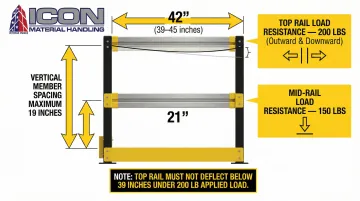
- Top rail must sit at 42 inches above the walking surface (acceptable range: 39–45 inches)
- Mid-rails are required wherever no wall or parapet of at least 21 inches exists; install approximately halfway between floor and top rail
- Vertical member spacing (mesh, screens, intermediate posts) must not exceed 19 inches
Load resistance minimums:
- Guardrail systems must withstand at least 200 lbs of force applied outward or downward within 2 inches of the top rail's upper edge
- Mid-rails and panels must withstand 150 lbs
- Top rail must not deflect below 39 inches under a 200 lb load
- These are OSHA floor thresholds — not performance targets for vehicle impact
Material and surface requirements:
- Steel and plastic banding are prohibited as top or mid-rails unless at least 0.25 inches in thickness or diameter
- All rail surfaces must be smooth and free of rough edges or projections — powder-coated finishes satisfy this requirement
- Rail ends must not overhang terminal posts unless the overhang creates no projection hazard
How to Install Warehouse Guard Rails (Step-by-Step)
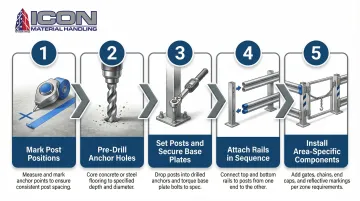
Guardrail installation follows a strict sequence: post placement, anchoring, rail attachment, and gate integration must happen in that order. Skipping torque checks or improvising anchor locations creates structural weaknesses that stay hidden until a forklift makes contact.
Step 1 — Mark post positions along the planned layout:
- Use chalk lines or tape to mark positions
- Confirm spacing matches manufacturer specifications for the selected rail system
- Account for corner posts, terminal posts, and any pass-through or gate openings before drilling begins
Step 2 — Pre-drill anchor holes for base plates:
- Use the correct bit diameter specified by the manufacturer
- Clean each hole of concrete dust and debris before setting anchors. Residual contamination is a leading cause of anchor loosening after impact
- Confirm hole depth matches the anchor bolt length
- Use an automated cleaning system like Hilti SafeSet (hollow drill bit + vacuum) to eliminate manual cleaning errors
Step 3 — Set posts upright and secure base plates:
- Torque anchor bolts to the manufacturer's specified foot-pound rating
- Use a spirit level on each post before final torque
- Note that both under-torquing and over-torquing compromise holding strength—do not estimate by feel
- Typical torque specifications: 50 ft-lb for 1/2" anchors, 110 ft-lb for 5/8" anchors, 185 ft-lb for 3/4" anchors
Step 4 — Attach rails in sequence:
- Bottom rail first (if the system includes one), then mid-rail at approximately 21 inches, then top rail
- Verify that rail ends seat flush against post connection points and do not overhang terminal posts
- Confirm top rail height measurement at each post location and record values for compliance documentation
Step 5 — Install area-specific components required by OSHA:
- Self-closing gates at ladderways, swinging or sliding away from the opening
- Removable rail sections at hoist openings (chains or gates allowed only if they provide "equivalent safety")
- Continuous rails along all unprotected ramp and runway edges
- Missing any of these components is a direct OSHA citation trigger — inspectors check them specifically
Post-Installation Checks and OSHA Validation
Once installation is complete, verification isn't optional — it's the step that confirms your system will actually perform under OSHA scrutiny. Work through each check in sequence before reopening the protected zone.
Rail Height and Mid-Rail Measurements
Measure top rail height at a minimum of three points per rail section — beginning, midpoint, and end. All readings must fall within the 39–45 inch range, with 42 inches as the target. Retain every measurement as part of your compliance documentation for OSHA inspections or incident investigations.
For mid-rail placement:
- Confirm the mid-rail sits at or near the halfway point between the floor and the top rail
- Verify that any mesh, screen, or vertical intermediate members leave no openings larger than 19 inches
- Check that no rail ends overhang terminal posts in a way that creates a snag or projection hazard
OSHA Load Test
Apply 200 lbs of outward and downward force within 2 inches of the top rail edge, then apply 150 lbs at the mid-rail in both directions. The system must hold without permanent deformation, post wobble, or anchor movement. A system that flexes and returns is passing; one that shifts and holds its new position is not.
Final Anchor Point Inspection
Before signing off, physically inspect every anchor point:
- Look for floor cracking or spalling around bolt locations
- Apply lateral hand pressure to each post to check for movement
- Run a hand along all rail surfaces to confirm no rough edges, weld spatter, or burrs
Complete and date a formal checklist before reopening the area to forklift and pedestrian traffic. That signed record is your proof of compliance — and your first line of defense if an incident ever occurs.
Common Warehouse Guard Rail Installation Problems and Fixes
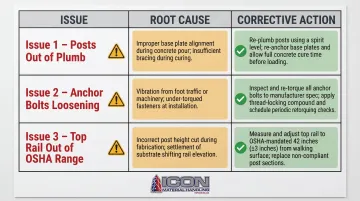
Issue 1: Posts Installed Out of Plumb or Spaced Beyond Manufacturer Spec
Posts that lean or sit wider than the manufacturer's specified spacing leave rail sections structurally weak—and unable to pass the 200 lb OSHA load test.
This typically happens when layout is marked without a level check, or post spacing is estimated rather than measured. Rushed installations to minimize downtime are a common trigger.
To correct it:
- Remove and reset non-plumb posts using a spirit level before attaching any rails
- If spacing exceeds spec, add intermediate posts rather than skipping them
- Never attach rails expecting the connection to compensate for post positioning errors
Issue 2: Anchor Bolts Loosening or Pulling Up After First Forklift Impact
When base plates shift, tilt, or visibly lift after even a minor forklift collision, the entire rail section's structural integrity is compromised.
The cause is almost always one of three things:
- Anchors set in damaged or thin-section concrete
- Holes not cleaned before anchor insertion
- Bolts under-torqued during installation
Steps to fix it:
- Remove the affected post and inspect the concrete beneath for sub-surface voids or delamination
- If the concrete is sound, re-drill, clean, and re-anchor with appropriate epoxy-set anchors
- If the floor is compromised, relocate the post to a structurally sound section
- Note: Manufacturer Evaluation Service Reports (ESRs) typically require a minimum concrete compressive strength of 2,500 psi
Issue 3: Top Rail Height Found Out of OSHA Range During Inspection
A top rail height below 39 inches or above 45 inches makes an installation non-compliant—even if the rail looks correct.
Posts fabricated or cut to the wrong length are the most common cause. Base plate shimming that raises or lowers post height without accounting for the effect on rail height is another.
To correct it:
- Replace posts with correctly dimensioned units per manufacturer specification
- Do not add riser plates or shim base plates above floor level to gain height—this destabilizes the post-to-floor connection and creates a new compliance problem
These three issues account for the majority of failed guard rail inspections. Catching them during installation—rather than after a compliance audit or incident—saves both time and cost.
Understanding Impact Performance: Rigid Steel vs. Flexible Polymer Systems
The single biggest factor separating rigid steel from flexible polymer guardrails isn't price — it's available clearance behind the barrier. Get that measurement wrong, and the system you choose can't do its job.
Rigid Steel Systems
Performance characteristics:
- Can stop a 13,000 lb load at 4 mph with limited deflection (~5-6 inches)
- Often suffer permanent deformation after impact and require rail replacement
- Transfer high loads to the floor, increasing the risk of concrete damage and anchor stress
- Best for tight clearance situations protecting critical assets
Typical applications:
- End-of-aisle racking protection where space is limited
- Equipment protection zones requiring minimal penetration distance
- Areas where visual confirmation of impact damage is preferred
Flexible Polymer Systems
Performance characteristics:
- Absorb energy (up to 7,000+ Joules) and rebound after impact
- Require greater clearance due to dynamic penetration distances of ~10 inches or more
- Significantly reduce floor damage and anchor stress by absorbing energy
- Rated for repeat impacts with minimal maintenance
Typical applications:
- High-traffic forklift aisles with frequent minor collisions
- Areas where floor preservation is a priority
- Facilities seeking to reduce long-term maintenance and replacement costs
Once you've compared both systems, four variables should drive your final selection:
- Fleet weight — size the barrier to your heaviest forklift (typically 9,000–20,000 lbs)
- Operating speed — account for typical aisle speeds of 3–7 mph when rating impact capacity
- Available clearance — measure the safe zone behind the barrier before committing to a flexible system
- Traffic volume — high-frequency collision areas get more long-term value from flexible systems' repeat-impact capability
Pro Tips for a Compliant, Long-Lasting Guard Rail Installation
Getting the installation right the first time saves significant rework. These three focus areas cover where to start, how to maintain integrity after incidents, and when to bring in outside help.
Start Where OSHA Citations Are Most Concentrated
Prioritize guardrail installation in the zones that generate the highest citation frequency:
- End-of-aisle racking
- Loading dock approach lanes
- Pedestrian crossing points adjacent to forklift aisles
Addressing these locations first targets the most commonly cited violations and delivers the fastest measurable reduction in collision risk.
Post-Impact Inspection Protocol
Any guardrail section that absorbs a significant forklift impact should be treated as potentially compromised until verified. Impact ratings apply to first-impact conditions and degrade with repeated collisions — a section that looks intact may no longer meet its rated load.
After any notable impact:
- Inspect anchor bolts and check floor integrity around base plates
- Verify rail geometry before returning the section to service
- Confirm anchor torque meets specification as part of the sign-off
Build this into a written protocol so inspections happen consistently, not only when damage is obvious.
When to Use Professional Installation
For straightforward single-level layouts, in-house installation is often workable. Facilities with more complex configurations benefit from professional crews — particularly when documentation requirements are strict.
Consider outside installation for:
- Multiple mezzanine levels
- Specialized zones such as hoist areas, automation cells, or cold storage
- Column clusters or non-standard floor configurations
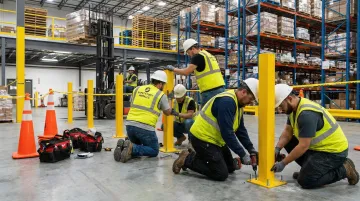
Icon Material Handling's fully insured installation team handles these projects with documented, OSHA-compliant systems and scheduling prioritized on a first-come-first-served basis — which matters when permit documentation or third-party sign-off is part of the process.
Conclusion
Warehouse guardrail installation is not a checkbox exercise. The quality of anchoring, dimensional accuracy, and area-specific compliance details directly determine whether the system will hold in the scenario it was installed to prevent. With OSHA penalties reaching $16,550 per serious violation and $165,514 for willful or repeated offenses as of January 2025, the financial and human cost of non-compliance is severe.
Approach installation with thorough pre-planning, disciplined execution of OSHA specifications, and a formal post-installation validation process before returning any protected area to active operations.
The difference between a compliant installation and a failed one often comes down to small details that carry major consequences when a forklift collision occurs:
- Proper hole cleaning before anchor insertion
- Accurate torque application on all fasteners
- Precise post height measurements at every anchor point
Frequently Asked Questions
What are OSHA's height requirements for warehouse guardrails?
OSHA requires top rails at 42 inches above the walking surface, with an acceptable range of 39-45 inches. Mid-rails must be installed at approximately 21 inches, roughly halfway between the floor and top rail. Any platform or surface four feet or more above a lower level requires guardrail installation.
Can I install warehouse guardrails myself, or do I need a professional?
Trained in-house teams can handle straightforward installations in low-risk zones. However, complex zones like mezzanines, hoist openings, and high-traffic forklift areas benefit from professional installers who provide documented compliance and reduce liability exposure.
What is the difference between rigid steel and flexible guardrails for warehouses?
Rigid steel is more economical and widely available but sustains visible damage on impact and may need more frequent replacement. Flexible polymer systems deform and return to shape, reducing repair frequency and floor damage over time. Flexible systems better absorb repeated impacts in high-traffic areas.
How often should warehouse guardrails be inspected after installation?
Conduct visual inspections daily in high-traffic PIT aisles, with comprehensive audits by a competent person annually. Perform a mandatory immediate post-impact inspection after any forklift collision, checking anchor points, rail geometry, and surface condition before returning the section to service.
Do guardrails need to be installed on mezzanines and elevated platforms in warehouses?
Yes, OSHA requires guardrails on any platform or surface four feet or more above the lower level. This includes mezzanine perimeters, stair landings, elevated picking platforms, and loading/unloading edges. Ladderways require self-closing gates, and hoist openings must have removable sections or equivalent barriers.
What happens if my warehouse guardrails don't meet OSHA standards?
Non-compliant guardrails can result in OSHA penalties of up to $16,550 per serious violation and $165,514 for willful or repeated offenses as of January 2025. Failure to abate a cited hazard incurs a daily penalty of $16,550. Beyond penalties, operational liability also rises sharply if an injury occurs at a non-compliant installation.