Introduction
North American big-box industrial rents averaged $8.08 per square foot in 2023—a 15.9% year-over-year increase—meaning every aisle you're not using is costing you money. For operations managers facing tighter margins and growing inventory volumes, that math makes storage density a top priority.
Drive-in racks offer a high-density compact pallet storage solution that eliminates wasted aisle space and significantly increases storage capacity within the same floor area. By allowing forklifts to drive directly into the rack structure, these systems can store up to 75% more pallets than selective racking in the same footprint.
This article covers how drive-in racks work, their structural components, key benefits, ideal use cases, and how they compare to other storage systems—helping you decide if this system is right for your warehouse.
TLDR
- Drive-in racks let forklifts drive directly into the rack structure to store and retrieve pallets on continuous rails
- They use LIFO (last-in, first-out) inventory and work best for low-SKU, high-volume inventory
- Storage capacity increases 40-75% over selective racking by eliminating most aisles
- Best suited for cold storage, food & beverage, and building materials with homogeneous, low-turnover stock
- Drive-through racks allow entry from both ends, enabling FIFO rotation for date-sensitive goods
What Are Drive-In Racks?
Drive-in racks are a high-density pallet storage system where the forklift physically enters the rack structure along internal rails to place or retrieve pallets. Unlike selective racks where each pallet has its own aisle-facing slot, drive-in systems stack multiple positions deep within a single lane—eliminating most of the aisle space in between.
That structural difference adds up fast. The same floor space holds 40-60% more pallets than selective racking, with some configurations reaching up to 75% capacity gains.
LIFO Inventory Method
Drive-in racks operate on a LIFO (last-in, first-out) inventory method. The last pallet loaded into a lane is the first one retrieved, since the forklift accesses the rack from a single entry/exit point. This works well for:
- Products that don't require strict date-based rotation
- Homogeneous goods (same SKU, large quantity)
- Products with stable shelf life
- Bulk commodities
- Cold storage and seasonal overflow inventory where space is the primary constraint
Density Advantage in Real Numbers
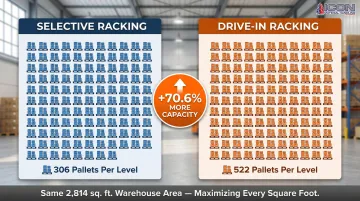
That LIFO trade-off—accepting limited selectivity in exchange for density—pays off in measurable terms. In a direct comparison using a 2,814 sq. ft. warehouse area, a selective rack layout yielded 306 pallets per level, while a drive-in layout yielded 522 pallets per level—a 70.6% increase in capacity. This means lower cost per pallet stored and better utilization of expensive warehouse real estate.
How Drive-In Racks Work: Key Components and Configuration
Structural Components
Upright frames and horizontal rails form the backbone of drive-in systems. Instead of traditional load beams, drive-in racks use continuous support rails running the depth of each lane. Pallets rest on their stringers or blocks on these rails, allowing the forklift to travel through the rack unobstructed.
Guide rails at floor level center the forklift as it drives into the lane, reducing the risk of accidental rack impacts. These floor guides are recommended to run the full depth of the system to minimize internal upright impact damage.
Top-tie beams and frame bracing are horizontal structural members that connect uprights across aisles for structural stability. Proper engineering determines spacing and load ratings based on:
- Pallet dimensions and weights
- Lane depth configuration
- Total system height
- Seismic requirements
Forklift and Operation Requirements
These structural elements define the physical envelope — and that envelope determines which forklifts can safely operate inside the system. Standard counterbalanced forklifts can work in drive-in rack systems, but equipment specifications must match the rack design. The Rack Manufacturers Institute (RMI) notes that reach trucks or vehicles with fixed outriggers (straddle trucks) are generally incompatible because the outriggers would interfere with the bottom rail or baseplates.
Critical forklift requirements:
- Sufficient mast height to elevate pallets above the top rail level
- Appropriate width to fit within lane dimensions with safe clearance
- Ability to maneuver 90° perpendicular to the rack before entering
Loading and unloading sequence:
- Forklift enters the lane with pallet elevated above rail level
- Travels to the deepest available position
- Lowers the pallet onto the support rails
- Reverses out (no room to turn around in a lane)
Key Benefits of Drive-In Racks for Compact Pallet Storage
Maximize Storage Capacity Without Expanding the Facility
Eliminating individual pick aisles between every rack row means the majority of floor space is used for storage, not forklift travel. A single block of drive-in racks consolidates what would otherwise require multiple rows with multiple aisles into one dense storage block.
Floor space utilization comparison:
- Selective racking: 30–40% utilization — most floor area is aisles
- Drive-in racking: 80–90% utilization — most floor area is active storage
That shift translates directly into lower cost per square foot of storage — particularly in high-rent markets where Northeast industrial asking rents are reaching $15.74 per sq. ft.
Lower Cost Per Pallet Position
While drive-in racks require more structural steel per lane than selective racking—due to continuous rails and frame bracing—the overall cost per pallet position tends to be lower. Far more pallets fit within the same real estate footprint, making them cost-effective in high-rent or space-constrained facilities.
Cost comparison:
- Selective racking: $50–$200 per pallet position
- Drive-in racking: $115–$500 per pallet position
- Net advantage: Despite higher upfront cost per position, drive-in delivers lower total cost when factoring in the eliminated need for additional building space
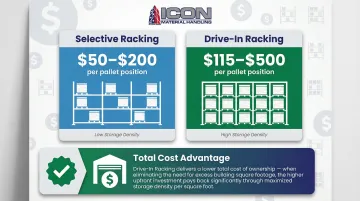
For facilities where expanding square footage isn't an option, that total-cost calculation often makes drive-in the only practical choice.
Versatility for Bulk and Cold Storage Operations
Drive-in racks deliver measurable gains in temperature-controlled or cold storage warehouses. Because they reduce the total refrigerated or frozen volume that must be maintained—fewer aisles means less air space to cool—operating energy costs can be reduced by 15-30%.
With refrigeration typically accounting for 60-70% of a cold storage facility's total electricity consumption, maximizing pallet density minimizes energy cost per pallet stored. Food distribution and pharmaceutical cold chain operations are among the strongest use cases for this reason.
Simplified Inventory Management for Bulk SKUs
For warehouses storing large quantities of a single or few SKUs—such as seasonal goods, building materials, or uniform consumer products—drive-in racks reduce the complexity of inventory management. Entire lanes are dedicated to one product type, making stock counting and replenishment straightforward.
The approach works best for operations with:
- Fewer than 10-15 SKUs making up the majority of pallet volume
- Products with low-to-medium turnover rates
- Consistently sized and weighted pallets
Drive-In vs. Drive-Through Racking: What's the Difference?
Core Structural Difference
Drive-in racks have a single entry/exit point per lane. Forklifts enter from one side, place or retrieve pallets, and back out the same way — no pass-through.
Drive-through racks open at both ends, letting forklifts enter from one side and exit from the other. That simple structural difference drives everything else about how each system performs.
Inventory Method Implication
Drive-in racks follow LIFO (last in, first out) — the last pallet loaded is the first retrieved. This works well when:
- Products are non-perishable and require no date rotation
- Maximum storage density is the priority
- Only a single aisle is available per lane
Drive-through racks follow FIFO (first in, first out) — pallets loaded first are retrieved first. This is the better fit when:
- Products require date rotation (food, beverages, pharmaceuticals)
- Compliance with food safety protocols is required
- High-turnover perishable goods need strict FIFO adherence
Facility Layout Implication
Drive-through racking requires aisle access on both ends of the rack block, which reduces overall space savings compared to pure drive-in. For operations storing perishables, that tradeoff is non-negotiable.
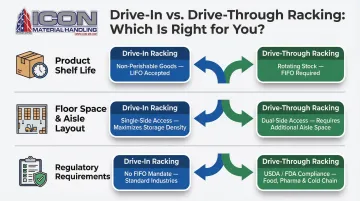
The right choice comes down to three factors:
- Product shelf life — non-perishables favor drive-in; rotating stock favors drive-through
- Floor space and aisle layout — drive-in requires access on one side only, maximizing density
- Regulatory requirements — USDA and FDA both recommend FIFO for perishable goods
Ideal Industries and Use Cases for Drive-In Racks
Drive-in racks perform best in operations with high pallet volumes, low SKU variety, and predictable inventory cycles. Here's where they deliver the most impact.
Primary Industries
Cold storage and food & beverage distribution
- Reduces refrigerated footprint, cutting energy costs in temperature-controlled spaces
- Handles high-volume loads of uniform pallet sizes efficiently
- Common application: beverage distribution centers storing identical cases by product line
Building materials and construction supply
- Accommodates large, heavy uniform loads — lumber, insulation, drywall
- Works well for products that don't require FIFO date rotation
- Low SKU count with consistent pallet dimensions makes lane assignment straightforward
Manufacturing facilities
- Bulk storage for raw materials and components
- Stages work-in-process inventory between production runs
- Holds finished goods in consolidated lanes awaiting shipment
Agricultural and seasonal product storage
- Suits crops and commodities with stable shelf lives stored in bulk
- Handles demand fluctuations by allowing entire lane consolidation or clearance during peak and off-peak cycles
Ideal SKU and Inventory Profile
Drive-in racks deliver the most value when your operation has:
- Fewer than 10–15 SKUs making up the majority of pallet volume
- Low-to-medium turnover rates — not high-frequency picking environments
- Consistently sized and weighted pallets, since each lane holds one SKU type
- Products that don't require strict FIFO rotation (or a drive-through layout is used)
When Drive-In Racks Are NOT the Right Choice
Avoid drive-in racks if your operation requires:
- High SKU variety with frequent individual pallet access
- Strict FIFO rotation and no budget for a drive-through configuration
- High-frequency picking from multiple SKUs at the same time
- On-demand access to any individual pallet regardless of lane position
In these scenarios, selective racking or a hybrid system may be more appropriate.
Drive-In Racks vs. Other High-Density Storage Systems
Comparison Matrix
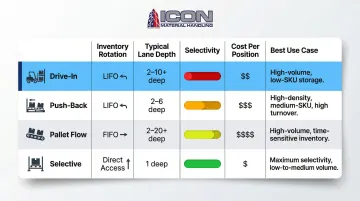
| System | Rotation | Typical Depth | Selectivity | Cost Per Position | Best Use Case |
|---|---|---|---|---|---|
| Drive-In | LIFO | 5-10+ pallets | Low | $115-$500 | Bulk, low-SKU, non-perishable |
| Push-Back | LIFO | 2-6 pallets | Moderate | $150-$400 | Medium-turnover, multi-SKU |
| Pallet Flow | FIFO | 2-20+ pallets | Moderate | $200-$450 | High-volume, date-sensitive |
| Selective | Direct access | 1 pallet | High | $50-$200 | High-SKU, frequent access |
Push-Back Racking
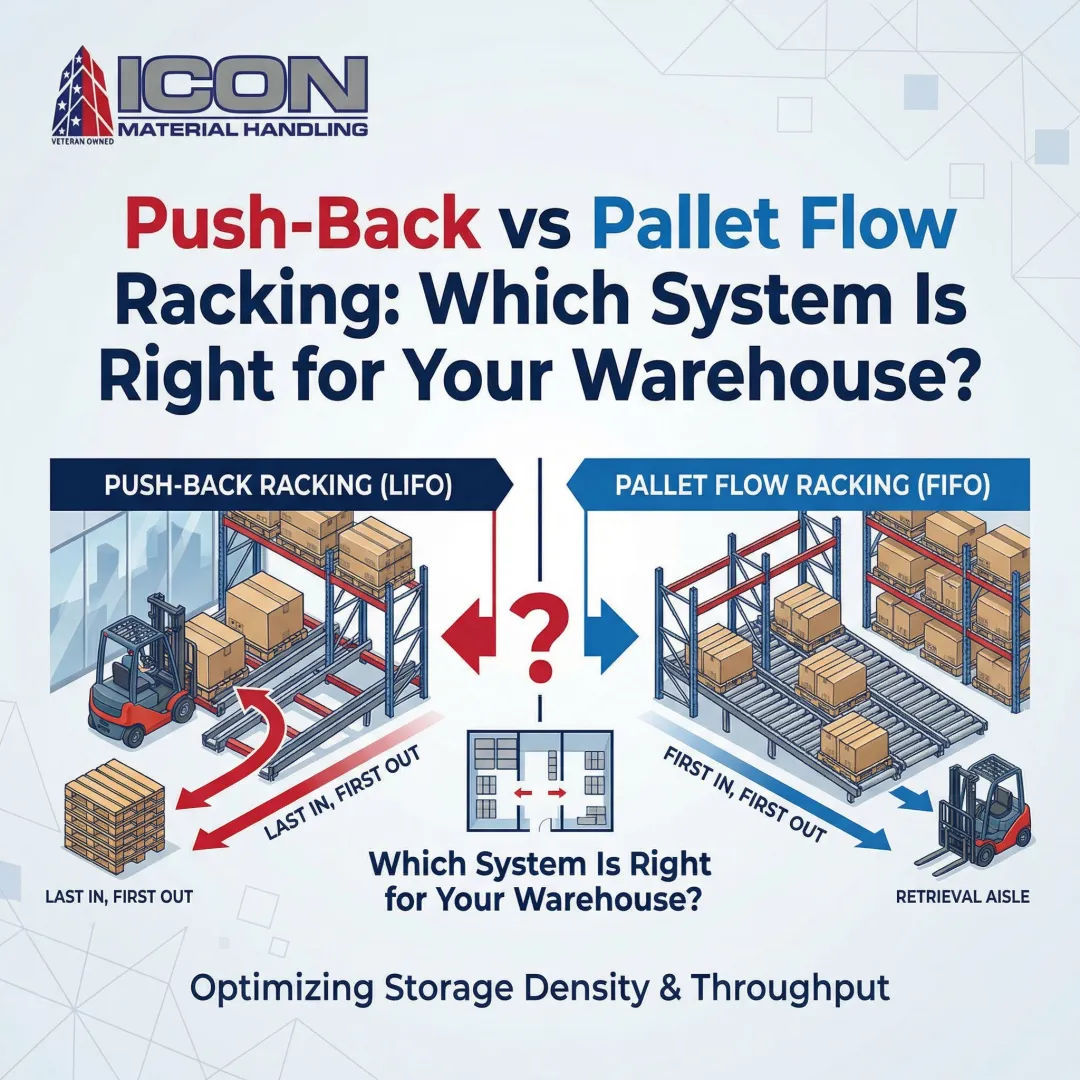
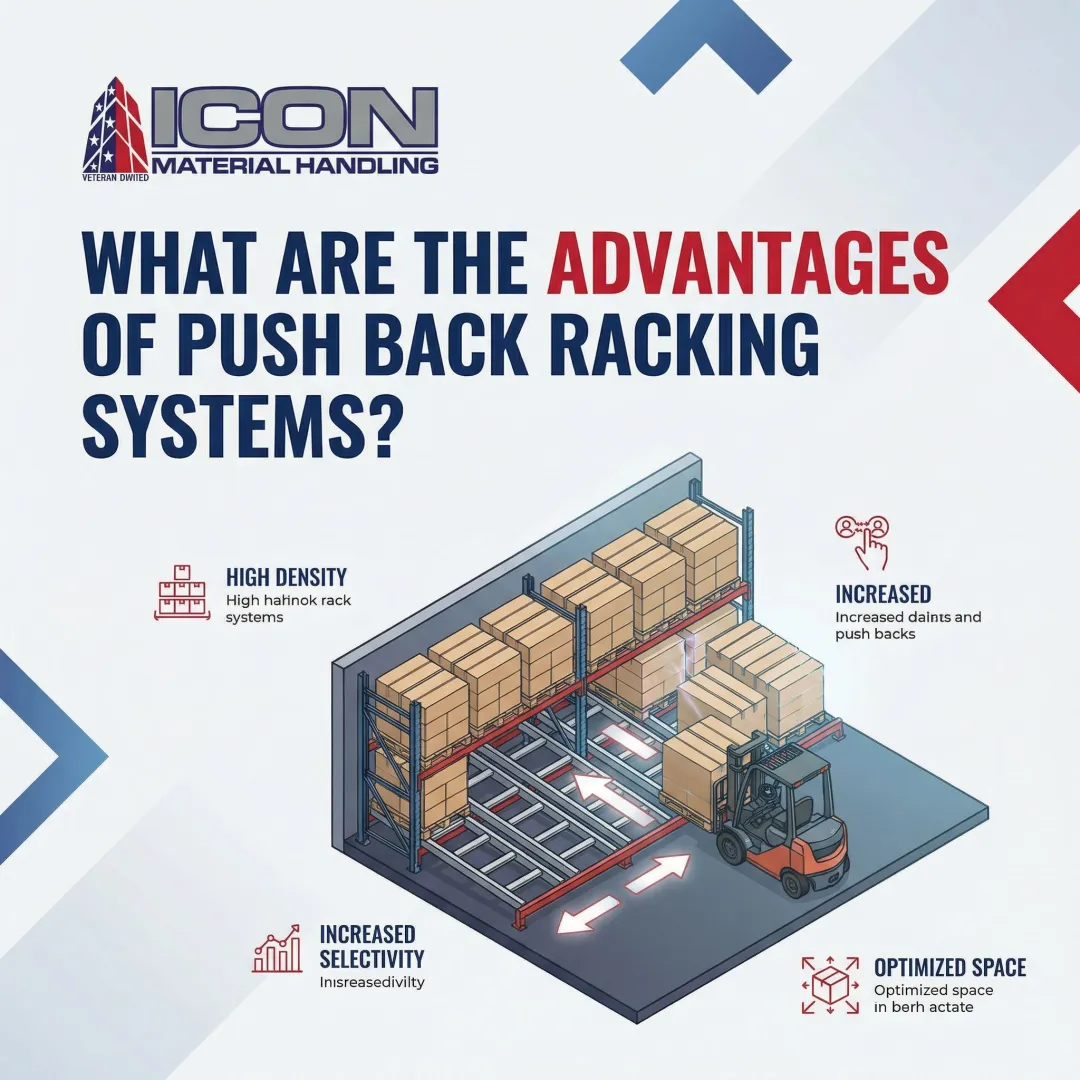
Push-back racks also use a single-entry LIFO system but hold fewer pallets deep—typically 2-6 positions. Pallets are placed on nested carts that glide on inclined rails. Forklifts don't enter the rack, increasing speed and safety compared to drive-in.
Push-back provides better selectivity per lane — you can access more SKUs from one aisle — but lower maximum density than drive-in. Push-back lanes cost around 65% of the price of comparable pallet flow but more than drive-in due to cart mechanics.
Pallet Flow Racking
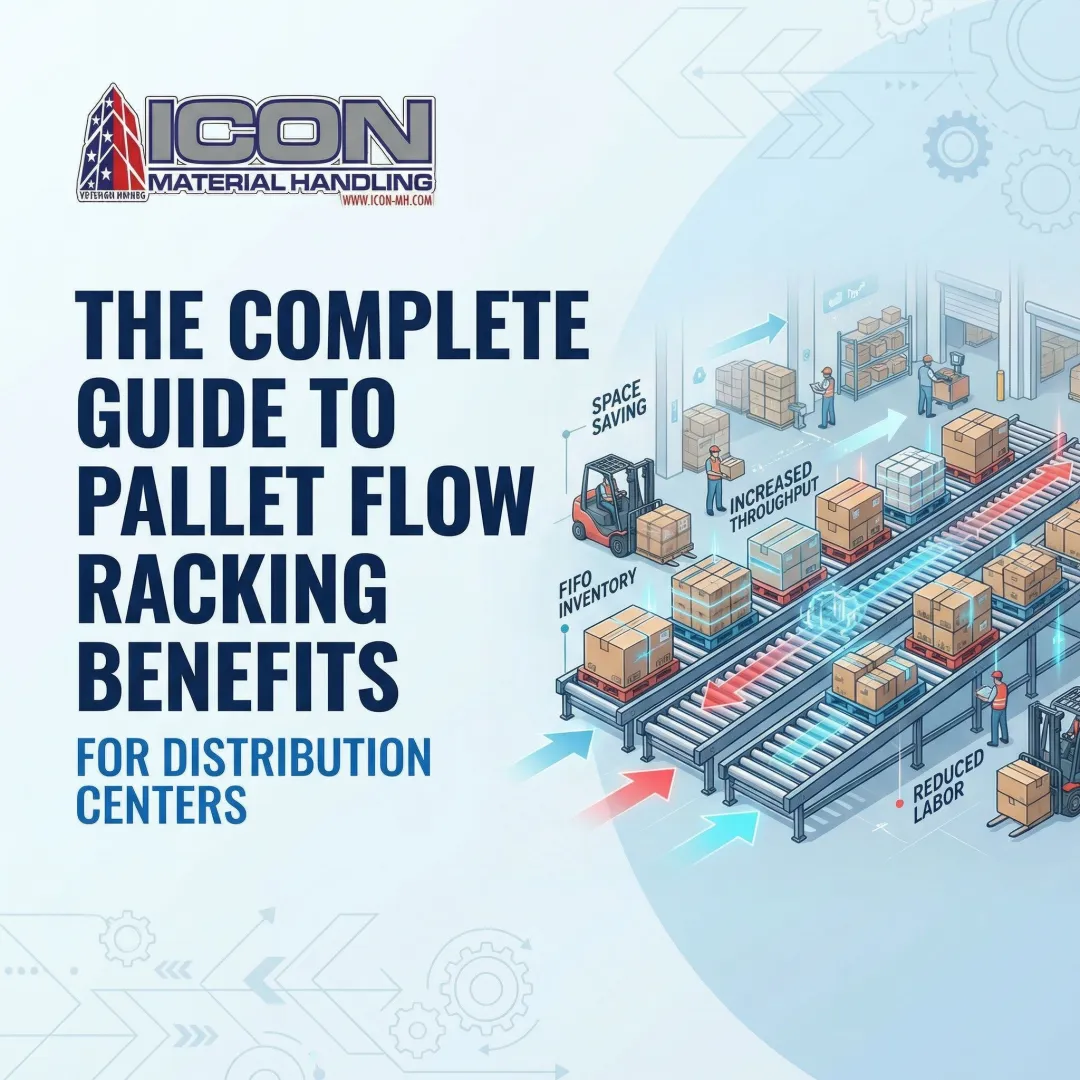
Pallet flow uses gravity-fed rollers and supports FIFO rotation with forklifts loading and unloading from separate aisles. Superior for date-sensitive products but higher in upfront cost and mechanical complexity.
When to choose pallet flow over drive-in:
- Products require strict date rotation
- High throughput with continuous replenishment
- Budget allows for $200-$450 per position
Drive-in is the better fit when:
- Products don't require FIFO
- Budget is constrained
- Simplicity and low maintenance are priorities
Selective Pallet Racking
Selective racking gives direct access to every pallet and works with all SKU profiles, but uses far more floor space for aisles. For operations where SKU count is low and pallet volume is high, the density gains of drive-in racks justify the trade-off in accessibility.
Consider a combined system: Many facilities benefit from using selective racking for high-variety, frequently accessed SKUs alongside drive-in racks for bulk storage needs. The result: fewer aisles dedicated to bulk stock, with full selectivity preserved where you need it most.
Frequently Asked Questions
What is the difference between drive-in and drive-through racking?
Drive-in racks have a single entry/exit point using LIFO inventory method, while drive-through racks have openings at both ends enabling FIFO rotation. The right choice depends on whether date-based product rotation is required for your inventory.
What inventory method do drive-in racks use?
Drive-in racks operate on a LIFO (last-in, first-out) method because pallets can only be accessed from one end of the lane. This makes them best suited for bulk goods that do not require strict date rotation.
How deep can drive-in rack lanes be configured?
Lane depth typically ranges from 2 to 8+ pallet positions depending on facility dimensions and forklift specs — deeper lanes increase density but reduce individual pallet access frequency. The RMI classifies 10+ positions as "extra-deep" and recommends dual-entry configurations at that depth.
Are drive-in racks a good solution for cold storage warehouses?
Yes, drive-in racks are particularly popular in cold storage and freezer warehouses because reducing aisle space lowers the total refrigerated volume, cutting energy consumption by 15–30% while maximizing pallet capacity within a temperature-controlled footprint.
What type of forklift is needed for drive-in racking?
Standard counterbalanced forklifts can be used, but the forklift must have sufficient mast height to elevate pallets above the storage rails and must be dimensioned to fit within the lane width. Confirm forklift selection during the rack design phase.
Can drive-in racks be combined with other racking systems in the same warehouse?
Yes — combining drive-in racks for bulk/uniform SKUs with selective pallet racking for high-variety, frequently accessed SKUs lets warehouses optimize both density and selectivity within the same facility.