Introduction
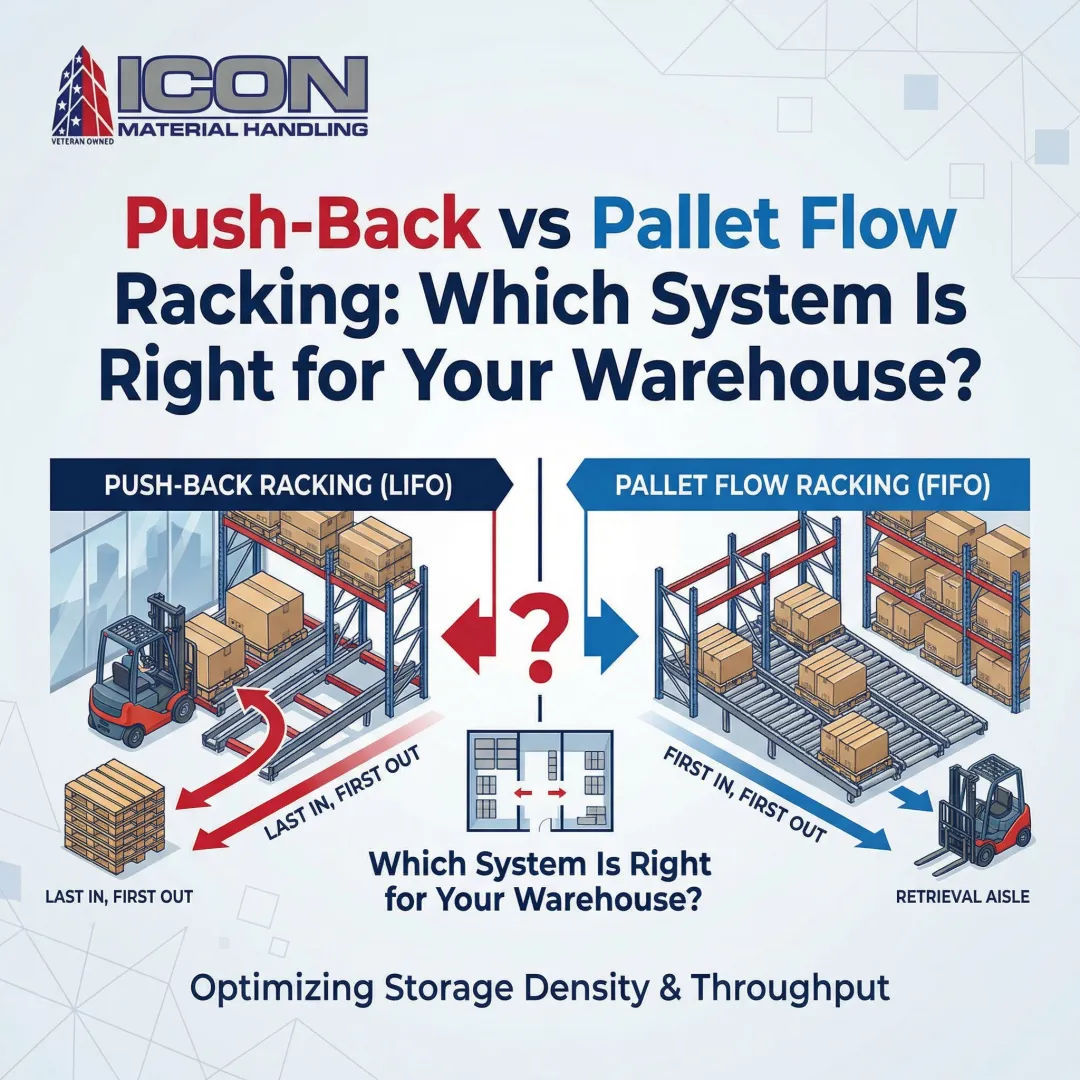
Pushback rack systems are high-density, Last-In/First-Out (LIFO) storage solutions used in warehouses and distribution centers to maximize cubic storage capacity. They work through nested wheeled carts on inclined rails — each new pallet pushes the previous one back, and gravity returns pallets to the pick face as they're removed.
Under normal conditions, these systems run reliably. But jams do occur, and they happen predictably when pallets, loads, or system components interact incorrectly.
When a jam does happen, the response matters enormously. Rear pallets can weigh well over 2,000 lbs each, and that stored energy creates serious crush and entrapment hazards the moment someone approaches without a plan. This guide walks you through the correct methods to clear jams safely — structured procedure first, speed second.
TL;DR
- Pushback jams stem from damaged pallets, debris, overhang, or side-shifting—not system design flaws
- Never enter a live, loaded pushback lane — crush injuries and pallet collapse are real risks
- Clear jams by purging with a forklift nudge, force loading from behind, or accessing an adjacent lane with fall protection
- If structural damage is visible post-jam, isolate the system and contact a qualified rack professional immediately
- For rack assessment, removal, or reinstallation, Icon Material Handling offers fully insured professional services nationwide
What Is a Pushback Rack System and Why Do Jams Occur?
System Mechanics
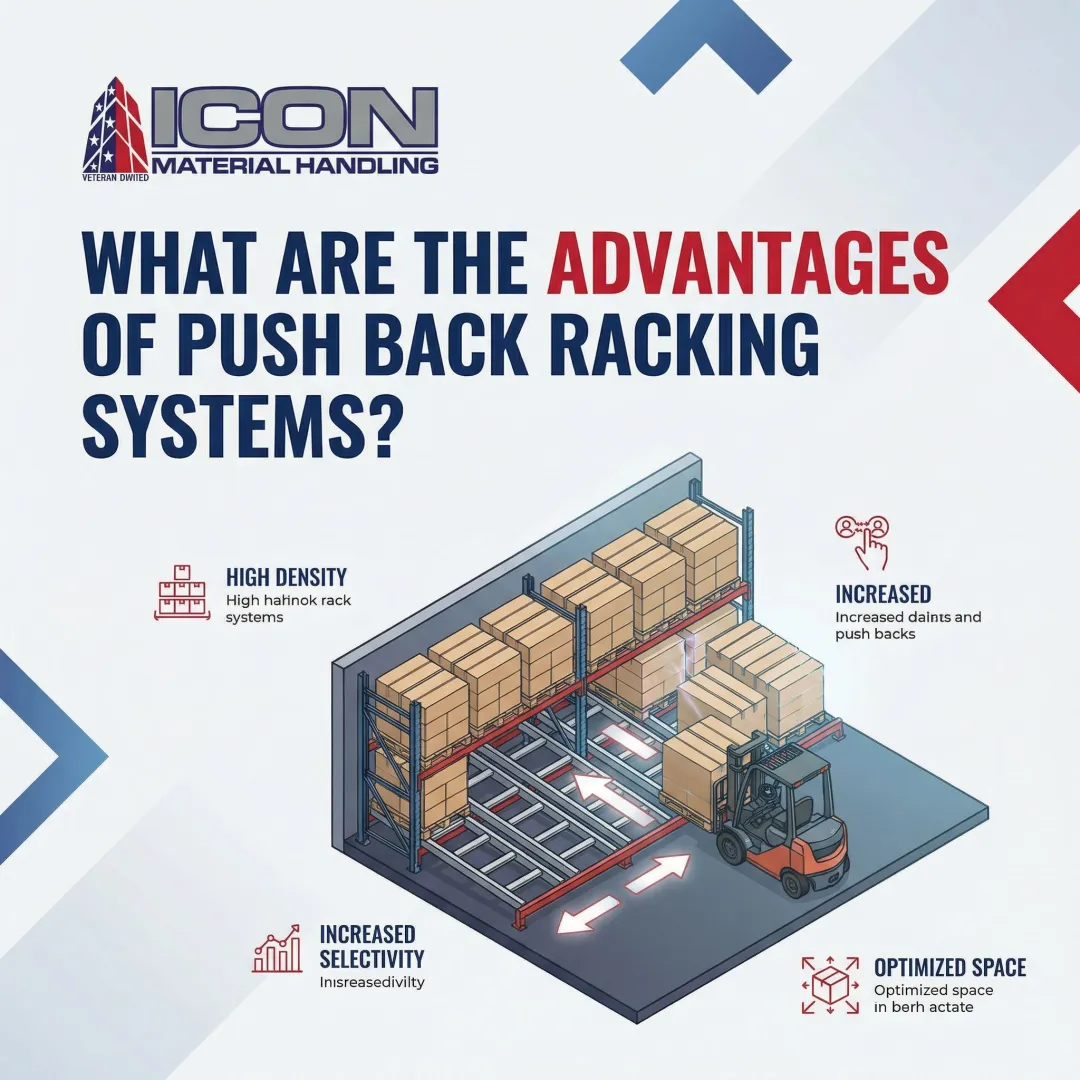
A pushback rack is a LIFO storage system where pallets sit on nested wheeled carts mounted on slightly inclined rails (typically 5/16-inch to 1/2-inch per foot). Each new pallet pushes the previous one back along the rail; when the front pallet is removed, gravity rolls the rear pallets forward to the pick face.
These systems offer 25% to 65% greater storage density than selective racking by using depth instead of aisle space — making them ideal for high-volume SKUs with multiple pallets per product.
Common Jam Causes
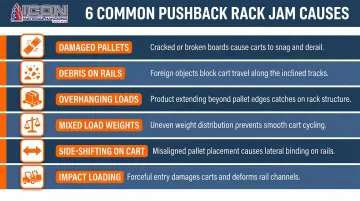
Pushback rack jams are predictable and preventable. They occur when specific interactions disrupt the smooth rolling of carts:
- Damaged pallets — Broken bottom boards, protruding nails, or split stringers snag on carts or rails. Use only GMA-style pallets with at least five intact bottom boards.
- Debris under cart wheels — Wood chips, shrink wrap fragments, or granular product on rails block free rolling. Regular rail cleaning eliminates this risk.
- Overhanging load items — Slip sheets, loose stretch wrap, or carton flaps catch on uprights or adjacent carts. Loads must be tightly unitized with no overhang.
- Mixed load weights — Heavier pallets pushing lighter ones can displace the lighter load, causing misalignment. Keep lane weights consistent with a maximum variance of 500 lbs.
- Side-shifting on the cart — Adjusting a pallet sideways while it rests on a cart can knock the cart off the rail. Center loads before placement and never side-shift once the pallet is on the cart.
- Impact loading — Dropping loads onto carts or backing out too fast jars loads loose. Control forklift placement and exit speed to prevent runaway pallets.
Most jams trace back to forklift operator habits or inadequate pallet inspection — not the rack itself. Recognizing the root cause determines whether the fix is a 10-minute rail sweep or a full lane evacuation.
Safety Rules You Must Follow Before You Attempt to Unjam
The Cardinal Rule
Never climb into a live, loaded pushback lane. The inclined carts and live load weight create a high potential for crush injuries, falling pallets, and rack collapse. The Rack Manufacturers Institute (RMI) explicitly prohibits entering a live, loaded lane to clear jams due to the severe injury risk from stored energy release.
Minimum Required Safety Preparations
Before any unjamming attempt begins:
- Alert all nearby forklift operators to the jam location before approaching
- Halt all loading and picking activity in affected lanes immediately
- Post visible warnings or barrier tape at both the pick aisle and the loading aisle
- Document the jam event for post-clearance review
OSHA and Fall Protection Requirements
OSHA does not have a rack-specific standard but enforces rack safety under the General Duty Clause (29 U.S.C. § 654(a)(1)), which requires employers to provide a workplace free from recognized hazards likely to cause death or serious harm.
Employers are commonly cited for unanchored racks, damaged columns, or missing load placards — with ANSI MH16.1 referenced as a "feasible and acceptable" method of abatement.
Any work above ground level in a rack system requires fall protection per 29 CFR 1910.28, which mandates fall protection for walking-working surfaces 4 feet or more above a lower level. If accessing a jam requires entering an adjacent lane at elevation, operators must use:
- Approved aerial lifts or man-lifts meeting ANSI A92.2 standards (29 CFR 1910.67)
- Forklift-mounted work platforms approved by the lift manufacturer (29 CFR 1910.178)
- Safety harnesses with tie-off anchors secured to the building structure, not the rack itself
Who Should Perform Unjamming
Only personnel who have received documented training on the pushback rack system and its components should attempt unjamming. Anyone without that training should contact a qualified rack inspector or the system manufacturer before proceeding.
How to Safely Unjam a Pushback Rack System
The correct approach depends on where the pallet is stuck and how severe the jam is. Start with the least invasive method and escalate only if needed. Never skip straight to entering the system.
Method 1: Purging the System (Forklift Nudge)
This is the first and safest approach to try:
- Position the forklift squarely at the pick face (aisle-facing end) of the jammed lane
- Lift the front pallet approximately 1 inch above the cart surface
- Firmly but gently push back against the load behind it by 3–4 inches
- Back out with the front pallet on the forks and observe whether the remaining pallets flow forward
This "nudge" method often resolves the jam without further intervention. If purging does not work, place the pallet back in position before inspecting further—do not leave the lane unloaded and unsecured.
Method 2: Force Loading from Behind
If purging fails, attempt to dislodge the stuck pallet from the loading end:
- Insert a new loaded pallet into the lane from the rear
- The weight and momentum may dislodge the stuck pallet as it travels down the incline
- Repeat by loading additional pallets if the first does not resolve the jam
- Stop if the lane fills completely without releasing the stuck pallet—continuing to load could worsen the jam or stress the rack structure
Method 3: Adjacent Lane Access (for Persistent Jams)
Escalate to this method if purging and force loading have both failed. It also applies when the jam is clearly caused by debris, a derailed cart, or structural damage that cannot be resolved remotely.
Step-by-step procedure:
- Remove all pallets from the adjacent lane bordering the jammed one
- Secure the now-empty adjacent lane with tie-offs and facility-mandated fall protection anchors
- Use an approved man-lift, maintenance cage, or forklift-mounted work platform (never an unsupported ladder) to enter the empty adjacent lane
- Visually assess the stuck pallet from the side—identify the obstruction (debris, broken board, displaced cart)
- Clear the obstruction from the side if safe to do so; if not, unload the stuck pallet from the side to remove weight before attempting to release the blockage
- Remove the stuck pallet entirely from the jammed lane using the forklift
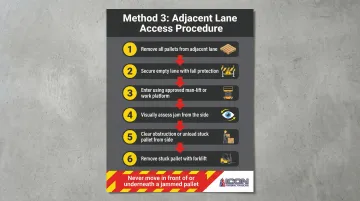
Never move in front of or underneath a jammed pallet load. Work from the side at all times and keep eyes on the load—pallets can shift without warning once an obstruction is cleared.
Validate the Fix Before Reloading
After clearing the jam, test the lane before reloading:
- Manually check that carts are properly seated on the rails and rolling freely
- Inspect rails for visible bending, cracking, or misalignment
- Remove any debris from rails and cart wheels
- Confirm that the first cart travels smoothly from the rear to the pick face position
Only reload the lane once the system has been confirmed functional. If the same lane jams again shortly after clearing, treat it as a sign of underlying rack damage and take the lane out of service until a qualified rack inspector can assess it.
Post-Clearance Inspection and Preventive Measures
Documented Post-Jam Inspection
After every jam event, conduct a documented inspection of the affected lane:
- Examine cart wheels for flat spots, cracking, or debris lodged in the axle
- Inspect inclined rails for deformation, cracking, or anchor displacement
- Clear pallet splinters, stretch wrap fragments, or other debris that could trigger a repeat jam
- Check uprights and beams for any impact damage caused during the jam or clearance
Once the lane is cleared and inspected, shift focus to prevention — most jams trace back to a handful of controllable loading habits.
Key Preventive Practices
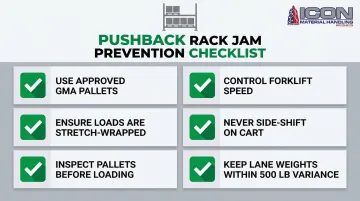
Reduce jam frequency with these controls:
- Use only pallet types approved for the system's design specifications (typically GMA-style with 5 intact bottom boards)
- Do not load pallets whose contents are not properly stretch-wrapped and unitized
- Inspect every pallet for broken boards, protruding fasteners, or overhanging product before insertion
- Control forklift speed during loading and removal to prevent pallet collisions
- Never side-shift a pallet while it rests on a cart
- Avoid mixing load weights in a single lane (500 lb. maximum variance)
Consistent loading discipline reduces jam frequency significantly — but it doesn't replace a formal inspection cadence.
Regular Inspection Schedule
RMI recommends formal inspections by a qualified professional at least annually, with daily or weekly operator visual checks for damage, debris, or out-of-plumb frames. Maintain a log tracking inspection dates, findings, and corrective actions.
When to Call a Professional Instead
Certain conditions indicate a jam has exceeded the capability of in-house resolution:
- Structural damage to uprights or beams after a jam event — do not reload until professionally assessed
- Bent or cracked rails that cannot be confirmed safe by visual inspection alone — requires a qualified rack inspector
- Broken or derailed cart wheels that cannot be reseated without disassembly — requires professional service
- Rack shifted from anchor points — poses an immediate safety and compliance risk; take the system out of service
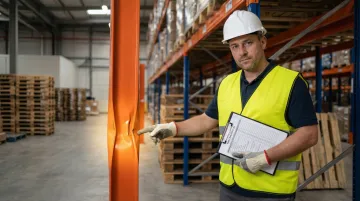
ANSI MH16.1-2023 is the governing standard for rack inspection and repair. When in doubt, the system should be taken out of service until a certified inspector evaluates it.
If your facility needs a professional assessment, Icon Material Handling offers fully insured rack installation, removal, and technical support services across the USA. Reach out at Sales@icon-mh.com or +1 248-971-1455 to schedule a consultation.
Frequently Asked Questions
What is a push back rack?
A pushback rack is a high-density, LIFO pallet storage system where pallets ride on nested wheeled carts mounted on inclined rails. Each new pallet pushes the previous one back, and pallets flow forward to the pick face as they are removed.
What are the OSHA rules for pallet racking?
OSHA does not have a rack-specific standard but enforces rack safety under the General Duty Clause (29 U.S.C. § 654). The industry standard is ANSI MH16.1, published by RMI, which governs rack design, installation, and inspection.
What is the weight limit for push back racking?
Weight limits vary by system design and manufacturer specifications. Pushback rack systems are typically engineered to support specific load capacities per level and per lane, often up to 3,000 lbs per pallet position. Always consult the system's load placard and LARC drawings for exact limits.
What causes a pushback rack to jam?
The most common causes are improperly loaded or damaged pallets, overhanging load items catching on rack components, debris under cart wheels, side-shifting a pallet on a cart, or mixing load weights in a single lane.
Can a forklift operator enter a pushback rack lane to clear a jam?
No. Operators should never enter a live, loaded pushback lane. If manual access is required, only a trained worker with proper fall protection may enter an adjacent lane — one that is fully cleared and secured first.
How often should pushback rack systems be inspected?
RMI recommends formal inspections by a qualified professional at least annually, with daily or weekly operator visual checks for damage, debris, or out-of-plumb frames per ANSI MH16.1 guidelines.