Introduction
Choosing the wrong high-density racking system can quietly drain a warehouse's budget — through excess labor, inventory errors, and wasted floor space that compounds over years. Push-back and pallet flow racking both use gravity to move pallets and can dramatically increase storage density, but they're built for different operations.
These systems represent significant capital investments. Getting the decision right — or wrong — shapes daily throughput, pick accuracy, and labor costs for years after installation.
This guide breaks down the key differentiators between the two systems:
- Inventory rotation method (FIFO vs. LIFO)
- Lane depth and storage density
- Aisle space requirements
- Upfront and total cost of ownership
- Best-fit applications by industry and operation type
TL;DR
- Push-back uses nested carts on inclined rails with single-aisle access (LIFO), typically 2–6 pallets deep
- Pallet flow relies on gravity rollers across sloped lanes, requires two aisles (FIFO), and can run up to 20 pallets deep
- Push-back costs roughly 65% of pallet flow and maximizes space in coolers/freezers
- Pallet flow works best for date-sensitive inventory like perishables and beverages
- A hybrid approach — push-back in some zones, pallet flow in others — is common and often the most practical solution
Push-Back vs. Pallet Flow: Quick Comparison
Inventory Method
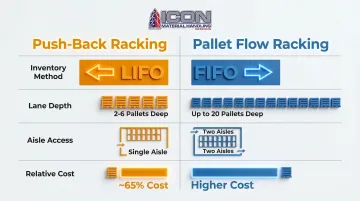
Push-back follows LIFO (Last-In, First-Out)—the most recently loaded pallet is retrieved first. This works well for non-perishable goods where stock rotation sequence isn't critical.
Pallet flow follows FIFO (First-In, First-Out)—the oldest pallet is always picked first. This automatic rotation is required for expiration-sensitive products and often mandated for regulatory compliance under FSMA or GMP standards. See how pallet flow and push-back compare on rotation requirements.
Lane Depth and Capacity
| Push-Back | Pallet Flow | |
|---|---|---|
| Max depth | 2–6 pallets (4 typical) | Up to 20 pallets |
| Best for | Multiple SKUs, moderate volume | Single-SKU, high-volume storage |
| Depth constraint | Nested carts limit vertical clearance | Deeper structural requirements |
Aisle Requirements
Push-back requires only one forklift aisle—loading and retrieval happen from the same side. This allows racks to be placed against walls, reclaiming floor space that would otherwise be an aisle.
Pallet flow requires two aisles—one for loading (charge end) and one for picking (discharge end). While this uses more floor space, it naturally separates inbound and outbound traffic, reducing forklift congestion and collision risk in busy facilities.
Cost
Industry estimates place push-back lane cost at roughly 65% of a comparable pallet flow lane—a difference driven by simpler mechanics: nested carts versus full roller beds with speed controllers and brakes.
Pallet flow costs more upfront because of those roller conveyors, speed controllers, and deeper structural requirements. Factor in labor: facilities running date-sensitive inventory often recover the cost gap through reduced handling errors and eliminated manual rotation steps.
Best Fit
Push-back suits:
- Moderate-turnover products
- Multiple SKUs with 2–6 pallets each
- Space-constrained areas (coolers, freezers)
- LIFO-tolerant inventory
Pallet flow suits:
- High-volume, date-sensitive inventory
- Fewer SKUs with larger quantities per SKU
- Operations requiring strict FIFO compliance
- Facilities with separate loading and picking zones
What Is Push-Back Racking?
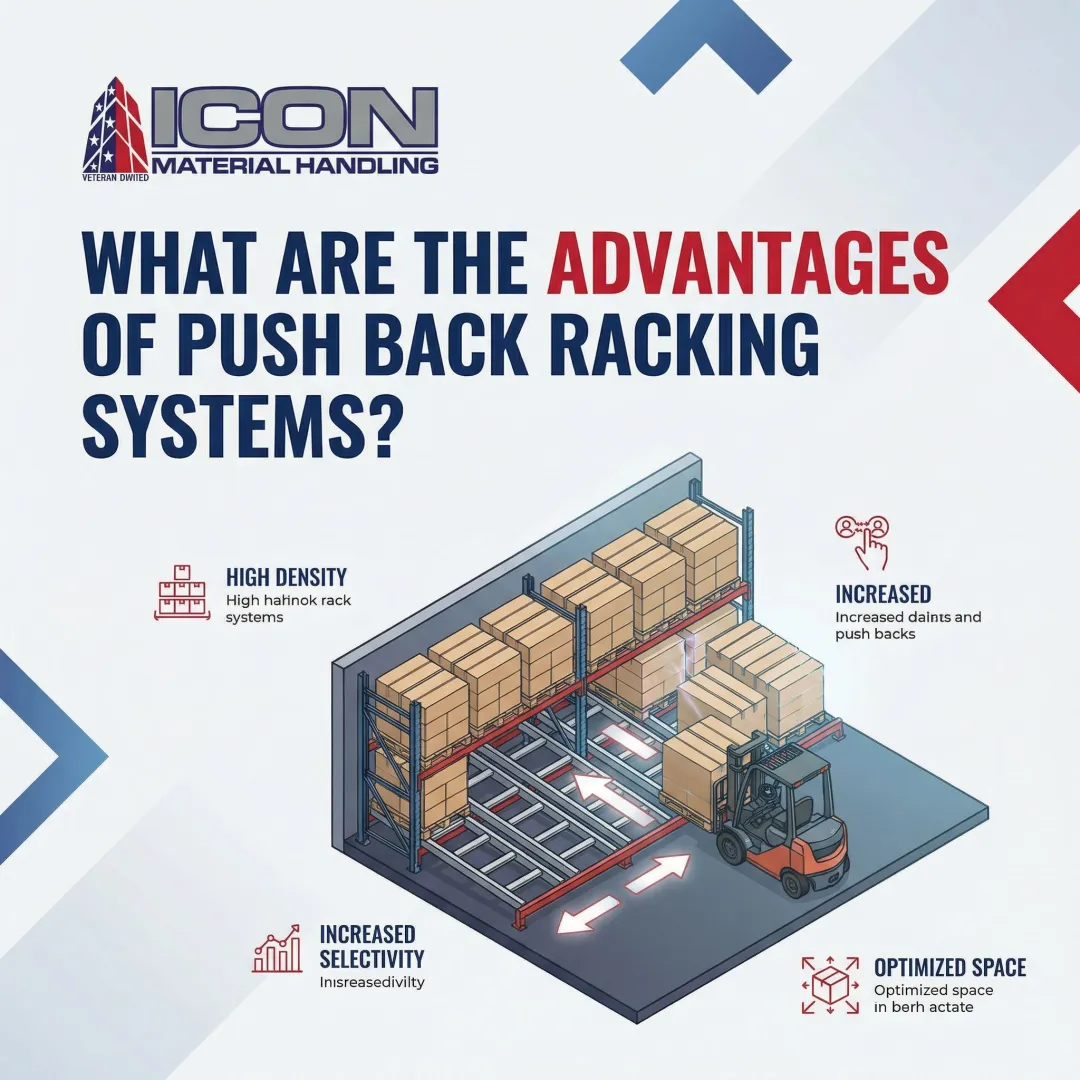
Push-back racking is a high-density, gravity-driven storage system where pallets rest on a series of nested carts that roll over inclined steel rails. Forklifts load pallets from the front, and each new pallet pushes the previous one deeper into the lane. When the front pallet is removed, the ones behind it glide forward automatically.
The mechanical design relies on inclined rail slope—typically 5/16" to ½" per foot—to control pallet movement speed. Because pallets travel only one position at a time during loading and unloading, braking mechanisms are not required, simplifying the system and reducing cost.
Use Cases of Push-Back Racking
Push-back excels in limited-space environments where every square foot counts:
- Cooler and freezer storage
- Wall-adjacent storage areas
- Facilities with moderate-turnover products carrying 2–6 pallets per SKU
The single-aisle design maximizes floor space utilization, and research shows push-back can increase storage density by up to 90% compared to selective racking.
Industries where push-back excels:
- Consumer packaged goods
- Beverages (non-perishable)
- Automotive parts
- Retail distribution
Push-back allows access to multiple SKU groups simultaneously from a single aisle — more flexible than drive-in racking while still delivering strong storage density at a lower cost than pallet flow.
One operational caveat worth flagging: pallet quality and uniformity matter. Push-back carts are designed around a specific pallet size, so damaged or inconsistent pallets can cause jams or operational slowdowns.
What Is Pallet Flow Racking?
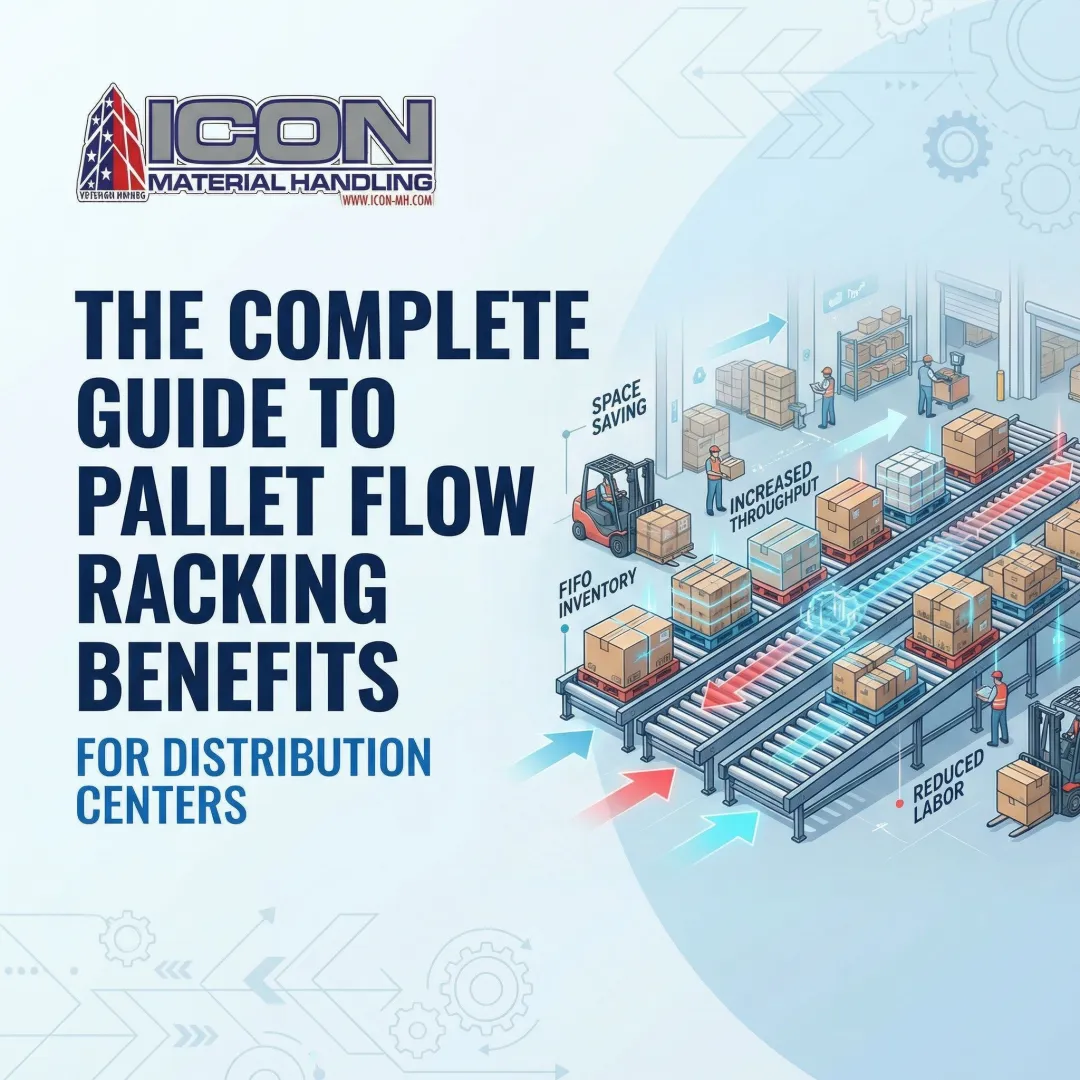
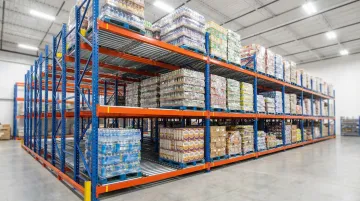
Pallet flow racking is a high-density, gravity-fed storage system where pallets enter from the charge (loading) end and ride down a sloped lane of rollers or wheels toward the discharge (picking) end. FIFO is automatic—the first pallet in is always the first pallet out, without any manual rotation effort.
The mechanical design includes speed controllers and brakes engineered into the lane to prevent pallets from building excessive momentum. This is critical for protecting fragile or sensitive products like glass or carbonated beverages. In shorter 2–3 deep lanes, brakes may not be required depending on load weight and stability — and the system can accommodate up to 20 pallets per lane.
Use Cases of Pallet Flow Racking
Pallet flow is ideal for food and beverage distribution where perishable goods, products with expiration dates, or date-coded items must be automatically rotated. It's also perfect for high-volume operations with a low SKU count and large quantities per SKU, where loading and picking happen in separate zones.
Industries where pallet flow dominates:
- Food and grocery distribution
- Pharmaceutical warehouses
- Beverage distributors
- Cold storage facilities handling dairy, produce, and frozen goods
Real-world impact:
- GLK Foods in Bear Creek, WI implemented a 5-high, 850-position pallet flow system that tripled on-site storage capacity and cut approximately 150 hours of forklift double-handling labor in a single harvest season.
- Boar's Head in Holland, MI added 260 pallet positions with a galvanized pallet flow pick module, eliminating approximately $2,000 per week in overtime costs previously spent searching for product.
Flexibility note: Some pallet flow lane designs handle multiple pallet sizes, making them more versatile than push-back in facilities with varied pallet dimensions. Pallet flow rails without brakes can also be repurposed as push-back lanes when operational needs change — a useful hedge if your storage strategy shifts over time.
Push-Back vs. Pallet Flow: Which System Is Right for Your Warehouse?
Decision Factor 1—Product Rotation Requirements
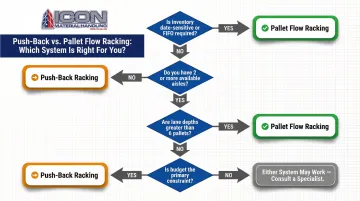
If any of your inventory is date-sensitive, has expiration dates, or requires strict FIFO compliance (food, pharma, beverages), pallet flow is non-negotiable. The automatic rotation eliminates manual handling and prevents spoilage.
If stock rotation order is not critical and LIFO is acceptable, push-back delivers the same density at a lower cost. However, using push-back for date-sensitive goods creates "honeycombing"—entire lanes must be emptied before replenishment to ensure older product is picked, which negates the density gains.
Decision Factor 2—SKU Profile and Lane Depth
| Push-Back | Pallet Flow | |
|---|---|---|
| Ideal SKU profile | Moderate SKU count, varied quantities | Fewer SKUs, high volume per SKU |
| Lane depth range | 2–6 pallets deep | 8–20 pallets deep |
| Depth limitation | Stacked carts reduce vertical clearance beyond 4 pallets | Density advantage compounds with deeper lanes |
Match your lane depth to the system — push-back loses vertical clearance as depth increases, while pallet flow becomes more efficient the deeper the lane runs.
Decision Factor 3—Space and Aisle Layout
Push-back's single-aisle access is a major advantage in constrained spaces—coolers, freezers, areas adjacent to walls or building columns. Higher density in temperature-controlled spaces directly reduces the volume of air that must be cooled, lowering energy costs.
Pallet flow's two-aisle requirement uses more floor space but yields higher density per bay and naturally separates forklift traffic for safety. In busy facilities with separate receiving and shipping operations, this separation reduces congestion and improves throughput.
Decision Factor 4—Budget and Fire/Code Considerations
Factor in not just the upfront cost difference but also fire code implications. Deep-lane systems (both push-back and pallet flow) may be classified as "solid shelf" storage under NFPA 13 (2022) if they lack 6-inch longitudinal and transverse flue spaces. That classification typically requires in-rack sprinkler systems at every tier level — a cost most facility planners don't anticipate. Check with your local fire authority early, and confirm that building column placement won't obstruct pallet flow lanes, which require fully unobstructed runs.
The Hybrid Approach
The two systems aren't mutually exclusive. Many distribution centers run pallet flow in perishable or high-rotation zones and push-back in cooler storage or non-perishable medium-turnover areas — each system doing what it does best.
Icon Material Handling's design team can assess your warehouse layout, SKU profile, and throughput needs to engineer a custom racking configuration—whether that means new or used systems—that maximizes your space without overcomplicating your operations. Contact Sales@icon-mh.com or call +1 248-971-1455 for a consultation.
Conclusion
There is no universal winner in the push-back vs. pallet flow debate. Each system solves a distinct operational problem: push-back delivers cost-effective density and single-aisle access for LIFO-tolerant inventory, while pallet flow handles automatic product rotation and deeper lane capacity for date-sensitive, high-volume SKUs.
The right choice comes down to how well each system matches your actual operation. Map your situation against these four factors before committing:
- SKU profiles — how many SKUs you're storing and their turnover rates
- Rotation requirements — whether LIFO is acceptable or FIFO is non-negotiable
- Aisle availability — how much floor space you can dedicate to access aisles
- Budget — upfront installation cost vs. long-term throughput value
Warehouses that work through these criteria systematically will land on a more defensible, cost-effective decision.
Contact Icon Material Handling to evaluate whether push-back, pallet flow, or a hybrid layout fits your facility — their team can review your SKU data, floor plan, and throughput goals to recommend the right configuration.
Frequently Asked Questions
Can push-back and pallet flow racking be used together in the same warehouse?
Yes, many distribution centers use a hybrid approach—pallet flow in perishable or high-rotation zones and push-back in areas with stable, lower-turnover inventory. The right mix depends on your SKU profile, rotation requirements, and how each zone is actually used day to day.
What is the main difference between FIFO and LIFO in racking systems?
FIFO (First-In, First-Out) means the oldest pallet is retrieved first — the method used in pallet flow systems. LIFO (Last-In, First-Out) means the most recently stored pallet is retrieved first — the method used in push-back systems. FIFO is essential for date-sensitive or perishable goods.
How deep can push-back racking go compared to pallet flow?
Push-back systems typically support 2–6 pallets deep, with 4 being the most common practical limit. Pallet flow systems can go up to 20 pallets deep per lane, making them the better option for large quantities of single-SKU products.
Is pallet flow racking always more expensive than push-back?
Yes, pallet flow generally costs more per pallet position due to roller conveyor components, speed controllers, and deeper structural requirements — industry estimates put push-back at roughly 65% of pallet flow cost. Factor in operational savings from automatic rotation, reduced labor, and spoilage prevention before making the final call.
Which system works better in cooler or freezer storage environments?
Push-back racking is often preferred in temperature-controlled spaces because it only requires one aisle, maximizing storage density in expensive cooler/freezer square footage. However, pallet flow can also be configured for cold storage when FIFO rotation of perishables is required.
Does pallet quality affect how push-back and pallet flow systems perform?
Yes, pallet quality is critical for both systems—damaged or inconsistent pallets can jam lanes or move unevenly. Push-back carts are designed for uniform pallet sizes, while some pallet flow designs can accommodate multiple pallet dimensions, making flow rack the stronger choice in facilities with varied pallet types.