Introduction
E-commerce warehouse operators face constant pressure: SKU counts multiply, order volumes climb, and seasonal demand spikes push facilities to their limits. Expanding the building footprint or relocating remains prohibitively expensive for most growing businesses. U.S. industrial asking rents hit $10.18 per square foot in Q4 2025, with one-third of markets seeing increases exceeding 50% since 2020. The cost of horizontal expansion has never been higher.
Mezzanine floors offer a proven vertical solution. By building upward rather than outward, warehouses unlock substantial new square footage for storage, picking, packing, and returns processing within the existing building envelope. For operations struggling to balance growth with budget constraints, a well-planned mezzanine can add 50–100% more usable floor space at a fraction of relocation costs.
This guide covers the types of mezzanine systems suited to e-commerce operations, key planning considerations, load and structural requirements, and how to evaluate the ROI before committing to a build.
TLDR
- Mezzanines double usable warehouse space vertically, ideal for fast-growing e-commerce operations constrained by high lease costs
- Support picking zones, packing stations, returns processing, office space, and automation equipment on elevated platforms
- Run $40–$150 per square foot installed, a fraction of what additional warehouse leases cost at $10.18/sf/year
- Key planning factors: 14–16 foot minimum ceiling height, floor load capacity, workflow design, and local permit requirements
Why E-Commerce Warehouses Are Running Out of Room
E-commerce fulfillment faces structural pressures that traditional retail distribution never encountered. Three forces drive most of the squeeze:
- Expanding SKU catalogs demand more pick faces and bin locations
- Rising order volumes require clearly separated workflows for receiving, picking, packing, shipping, and returns
- Seasonal surges—particularly Q4 peak—can overwhelm even well-organized facilities, forcing operators to rent overflow space or turn away business
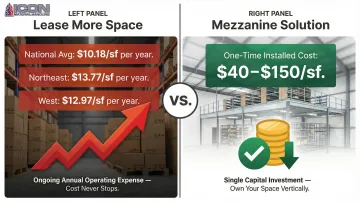
Those pressures push operators toward conventional fixes—leasing more space or relocating entirely—but the economics rarely hold up. With industrial rents at $10.18/sf/year nationally and premium markets in the Northeast averaging $13.77/sf and the West at $12.97/sf, leasing additional warehouse space carries a recurring cost burden that compounds annually. Relocating to a larger facility involves even greater expense: moving costs, lease penalties, operational downtime, and the risk of service disruptions during the transition.
Most warehouse facilities already hold the answer overhead. Modern distribution centers increasingly feature 32–40 foot clear heights, yet many operations use only the ground-level footprint.
Mezzanines convert that unused cubic footage into productive operational area—effectively doubling usable square footage without expanding the building's walls.
What Is a Mezzanine Floor and What Types Exist?
A warehouse mezzanine is a free-standing structural platform installed inside an existing facility to create a second (or third) usable level. Unlike shelving or a catwalk, it's a true engineered floor designed to support people, equipment, and inventory.
Under the International Building Code (IBC), a mezzanine is an intermediate level between the floor and ceiling that remains part of the story below — it does not count as an additional building story.
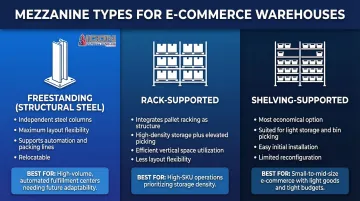
Freestanding (Structural Steel) Mezzanines
Freestanding mezzanines are self-supported by steel columns anchored directly to the warehouse floor. This makes them the most flexible option since they don't rely on existing racking or building structure. They're ideal for e-commerce operations needing large open platforms for:
- Packing lines and quality control stations
- Returns processing and inspection areas
- Office space and supervisor stations
- Conveyor support and automation equipment
Freestanding systems use bolt-together connections, allowing them to be disassembled, relocated, and reassembled at a new facility—an important consideration for growing businesses.
Rack-Supported Mezzanines
For operations where storage density and platform access need to work together, rack-supported mezzanines offer a more integrated approach. These systems use pallet racking as the structural support, combining storage and elevated platform into one unified system — well-suited for high-SKU environments where picking access is needed on multiple levels.
The racking below supports pallets or bulk storage, while the platform above houses picking zones or equipment. This design maximizes cubic utilization but offers less layout flexibility than freestanding systems, since the structure ties directly to the racking configuration.
Shelving-Supported Mezzanines
Where storage requirements are lighter, shelving-supported configurations are the most economical choice. These suit small-parts storage, bin shelving pick zones, or returns staging — the shelving units themselves bear the load of the platform above.
The tradeoff is flexibility. Because the structure ties directly to the shelving layout, reconfiguration is more complex than with freestanding or rack-supported systems.
Icon Material Handling designs and installs freestanding and rack-supported mezzanine systems built to match the layout, load requirements, and workflow of e-commerce fulfillment operations across the USA.
Key Uses of Mezzanine Floors in E-Commerce Fulfillment Centers
Picking and Storage Zones
Mezzanines create dedicated upper-level pick floors with bin shelving or flow rack, separating high-velocity small-item picking from bulk pallet storage below. This vertical separation improves pick accuracy and reduces floor-level congestion, allowing pickers to work without navigating around forklifts or inbound shipments.
Packing and Sorting Areas
Mezzanine levels can house dedicated packing stations and sorting lines, fed by conveyors or vertical lifts from the main floor. This allows packing operations to run simultaneously with receiving and shipping below—without cross-traffic bottlenecks that slow throughput during peak periods.
Returns Processing
Returns are one of the most space-intensive and disorganized workflows in e-commerce fulfillment. A dedicated mezzanine level for returns inspection, repackaging, and restocking keeps this function separated from outbound operations. This separation improves speed and accuracy while preventing returned inventory from cluttering active picking zones.
Elevated Office and Supervisor Space
Mezzanines place management offices, supervisor stations, or break areas directly above the warehouse floor—keeping leadership close to operations without consuming ground-level square footage. The elevated position also provides clear sightlines across the full warehouse floor, which makes real-time oversight practical rather than reactive.
Automation and Equipment Platforms
Mezzanines provide stable elevated platforms for automation equipment. Common installations include:
- AMRs (autonomous mobile robots)
- Conveyors and carton elevators
- Sortation systems and transfer stations
Planning for automation from the start matters—structural modifications post-installation are expensive and disruptive. Icon Material Handling's conveyance and automation solutions can be engineered directly into custom mezzanine platforms, so equipment, structure, and material flow are designed as one system rather than retrofitted together.
Benefits of Adding a Mezzanine to Your E-Commerce Warehouse
Space Maximization Without Relocation
A mezzanine can effectively double usable floor area within the existing facility. Research confirms that mezzanines can double or triple storage capacity within the same footprint. Compared to leasing additional warehouse space at $10.18/sf/year, a one-time installed cost of $40–$150/sf delivers a clear financial advantage.
Cost Savings and ROI
Mezzanines typically cost significantly less than expanding a building or signing a new lease. With installed costs averaging $40–$150 per square foot, many projects achieve ROI payback in approximately 2.5 years compared to leasing equivalent space.
Mezzanines are generally classified as tangible personal property rather than real property in the U.S., which may qualify them for accelerated depreciation. For tax years beginning in 2025, the Section 179 expense limit has increased to $2.5 million, potentially allowing immediate expensing of qualifying mezzanine equipment platforms. Bonus depreciation is 40% for 2025 and steps down to 20% in 2026. Note: Tax rules are complex and subject to change—consult a qualified tax advisor to determine eligibility.
Scalability to Match Business Growth
Mezzanines support phased growth without requiring a new facility commitment. A single-level structure can be extended horizontally or built upward with a second tier as order volume scales — keeping capital tied to infrastructure, not locked into a long-term lease.
Minimal Disruption During Installation
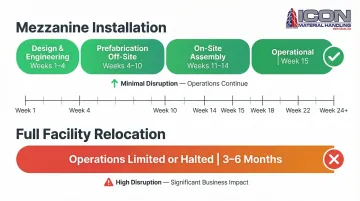
Mezzanines are largely prefabricated off-site and assembled on-site while warehouse operations continue. Typical projects run 10 to 15 weeks from design approval to completion, with on-site installation taking just 2–4 weeks. A full facility expansion or relocation, by comparison, routinely shuts down or limits operations for three to six months.
What to Consider Before Installing a Warehouse Mezzanine
Structural and Spatial Requirements
Three non-negotiable pre-installation checks must be completed:
- Clear ceiling height: Typically a minimum of 14–16 feet is needed to comfortably accommodate a mezzanine with safe working clearances on both levels (IBC requires 7 feet minimum above and below the mezzanine floor)
- Existing floor slab load rating: The concrete slab must support column footings and the concentrated loads they impose
- Available square footage footprint: The mezzanine area generally cannot exceed one-third of the room area under standard IBC rules (exceptions exist for sprinklered buildings and special industrial occupancies)
Get a structural engineer or mezzanine specialist to assess these factors before design work starts — skipping this step is the most common cause of costly mid-project redesigns.
Workflow and Slotting Design
The operational layout matters as much as the physical structure. Key decisions include:
- Aisle width and clearances for material handling equipment
- SKU velocity placement (fast movers near conveyor drop-offs or stairways)
- Labor flow between levels and tote/cart return paths
- Integration points for conveyors, lifts, or automation equipment
These must all be planned before installation, since post-installation changes are expensive. Involving all stakeholders early—including frontline workers—pays off in smoother implementation and better adoption.
Permits, Compliance, and Safety
Permit requirements vary by state and municipality. Depending on jurisdiction, you may need stamped engineering drawings, fire suppression system adjustments, or a formal occupancy permit. Confirm local code requirements before installation begins — your installation contractor should be able to point you in the right direction.
OSHA compliance is non-negotiable. Requirements include:
- Guardrails: Top rail height must be 42 inches (±3 inches) and withstand a 200 lb force
- Toeboards: Minimum 3.5 inches high with ≤0.25-inch clearance to prevent falling objects
- Stairs and handrails: Must meet specific height and load requirements
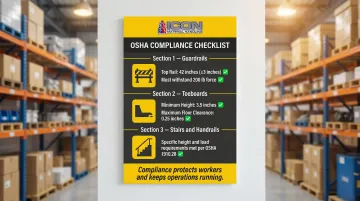
Meeting these requirements isn't just about avoiding fines — it protects your workers and keeps your operation running. Icon Material Handling's fully insured installation team manages the build process from structural setup to safety compliance, so your facility is operational and code-ready from day one.
Frequently Asked Questions
How much does a mezzanine floor cost for an e-commerce warehouse?
Cost varies widely based on size, type (freestanding vs. rack-supported), load requirements, and finishes. Industry benchmarks place installed costs at $40–$150 per square foot, with basic storage platforms at the lower end and heavy-duty or multi-tier systems at the higher end. Contact a mezzanine supplier for project-specific pricing.
Do I need a building permit to install a mezzanine in my warehouse?
Permit requirements vary by state and local municipality. Some jurisdictions treat mezzanines as internal equipment requiring only engineering sign-off, while others require full building permits and fire code compliance. Always verify with local authorities before installation.
How long does it take to install a warehouse mezzanine?
Typical projects take 10 to 15 weeks from design approval to completion. Prefabricated systems install faster than custom steel builds. On-site installation typically takes 2–4 weeks, and most systems are designed to minimize disruption to ongoing warehouse operations.
What is the typical weight capacity of a warehouse mezzanine floor?
Common load ratings include 125 psf for light storage, 250 psf for heavy storage, and 50 psf for office areas. Specialized equipment applications can reach 300+ psf, engineered to order.
Can a warehouse mezzanine be relocated or expanded after installation?
Yes. Freestanding mezzanines use bolt-together connections and can generally be disassembled and relocated, making them a flexible long-term asset. Many systems are also designed to allow horizontal expansion or the addition of a second tier as operational needs grow.
What is the difference between a rack-supported and a freestanding mezzanine?
A freestanding mezzanine stands on independent steel columns, offering layout flexibility suited to open work areas or automation platforms. A rack-supported mezzanine integrates pallet racking as its structural base—ideal for high-density inventory environments that need combined storage and elevated access.