Introduction
Warehouses are under pressure from every direction. Industrial lease rates keep climbing, SKU counts expand to meet customer demand, and fulfillment speed expectations rise — all while available square footage stays fixed.
Push back racking gets cited as a high-density storage solution, but the specifics — what it actually changes in labor hours, floor utilization, and storage economics — rarely get a straight answer. This article covers the real-world advantages of push back racking and when they matter most for warehouses and distribution operations.
TL;DR
- Push back racking stores pallets 2–6 deep per lane using gravity-fed nested carts, increasing storage density by 25–65%
- Fewer aisles means lower real estate cost per pallet — no facility expansion required
- Single-aisle loading and unloading cuts forklift cycle time by 25–40% and reduces accident exposure
- Structural steel construction and minimal moving parts keep maintenance costs lower than most high-density alternatives
- Best suited for operations with multiple pallets per SKU and medium-to-high inventory turnover
What Is Push Back Racking?
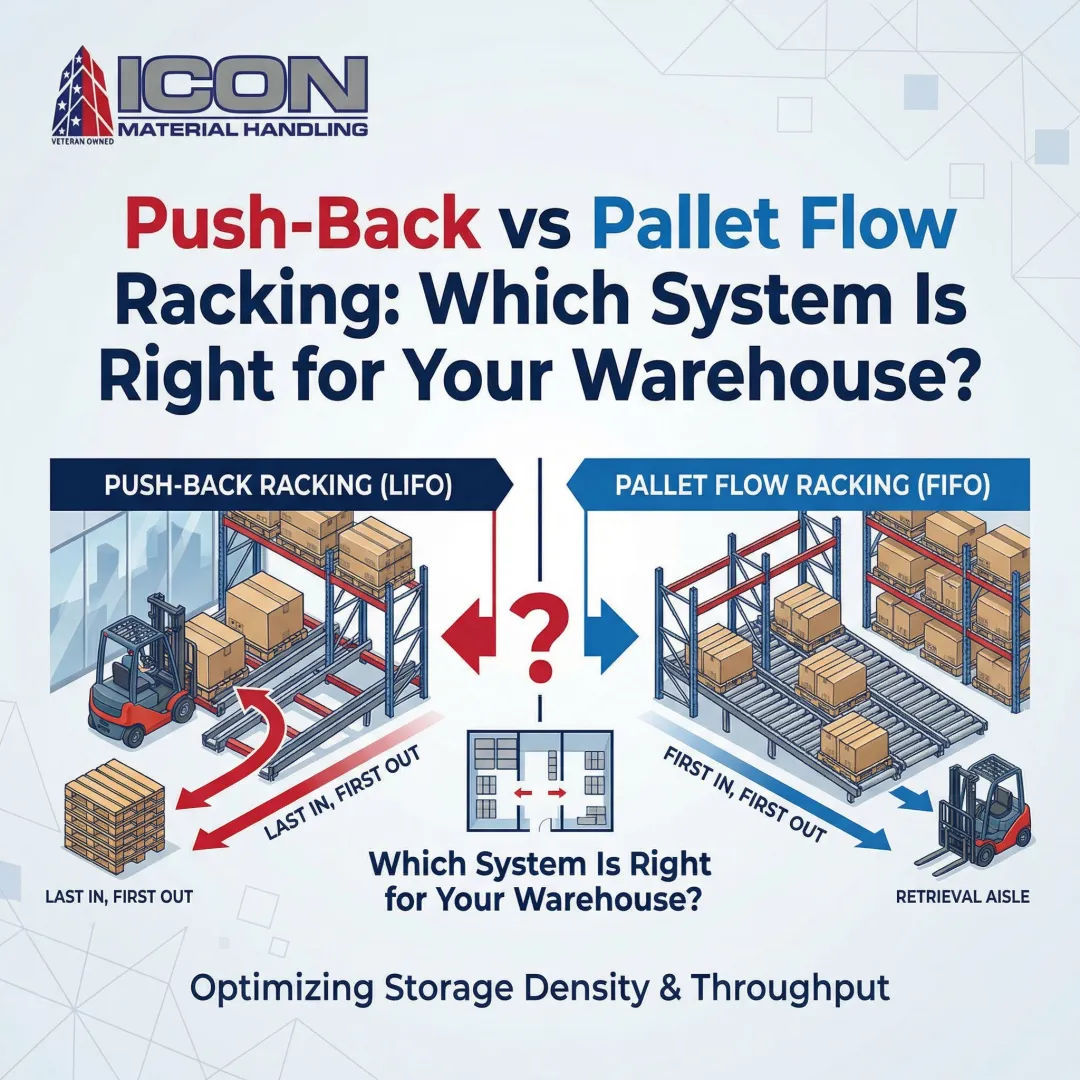
Push back racking is a pallet storage system where pallets sit on nested wheeled carts riding on inclined rails, allowing 2–6 pallets to be stored deep per lane from a single aisle. When a forklift loads a pallet, it pushes existing pallets back along the rails; when the front pallet is removed, gravity automatically rolls the remaining pallets forward to the picking face.
The system is used across a wide range of facilities, including:
- Warehouses and distribution centers
- 3PL and fulfillment operations
- Food and retail distribution
- Manufacturing plants
- Cold storage environments
The result: more storage in less space, faster picking cycles, and lower operating costs.
Key Advantages of Push Back Racking
Push back racking affects the metrics that matter most to warehouse managers: cost per pallet position, forklift cycle time, incident rates, and total storage capacity. Here's how each advantage plays out in practice.
Advantage 1: Higher Storage Density Without Expanding Your Footprint
Push back racking stores multiple pallets deep per lane, which directly reduces the number of aisles needed and converts that reclaimed space into additional storage positions.
How this works in practice:
A facility that previously needed one aisle for every two rack rows can consolidate lanes, using the same floor area to hold significantly more pallets. According to the Rack Manufacturers Institute (RMI), push back racking delivers cubic densities approximately 25% to 65% greater than selective racking.
Real-world capacity improvements:
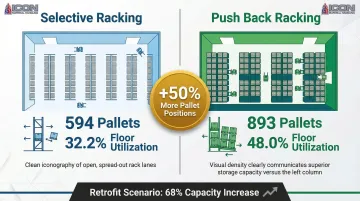
- Interlake Mecalux documented a 19,030 sq. ft. comparison where push back achieved 893 pallets per level (48.0% floor utilization) versus 594 pallets (32.2% utilization) for selective racking — a 50% increase in pallet positions
- Retrofit case study: 3D Storage Systems documented a project where switching from selective to 5-deep push back increased capacity from 1,860 to 3,120 pallet positions in the same footprint — a 68% increase
Warehouse lease and ownership costs are calculated per square foot; every aisle eliminated is recovered storage value. With U.S. industrial asking rents averaging $10.18 per square foot NNN nationally — and reaching $13.77 in the Northeast and $12.97 in the West — each square foot of reclaimed aisle space represents direct cost savings.
Vertical space is also maximized: push back carts nest with minimal height loss, typically consuming just 2.15 to 7.46 inches of vertical bay height depending on lane depth, preserving usable bay height for taller pallet loads. Facilities facing capacity constraints can avoid costly expansions or off-site storage contracts by increasing density in-place.
KPIs impacted:
- Pallets stored per square foot
- Cost per pallet position
- Storage utilization rate
- Off-site storage spend
When this advantage matters most:
Operations running near or at storage capacity, facilities with high SKU counts and multiple pallets per product, and businesses looking to delay or avoid warehouse expansion.
Advantage 2: Faster Operations and Improved Workplace Safety
Push back racking eliminates the need for forklifts to enter the rack structure. Operators load and unload from the aisle face only, with remaining pallets automatically flowing forward by gravity when the front pallet is removed.
The real-world process change:
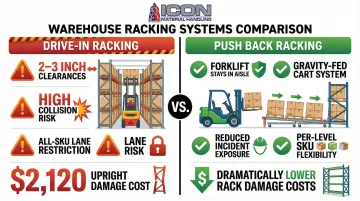
Compared to drive-in racking where operators must navigate deep into lanes — increasing time per pick and collision risk — push back delivers the next pallet to the picking position automatically, cutting forklift travel distance per retrieval. Industry studies indicate push back systems can reduce loading and unloading times by 25% to 40% compared to drive-in systems.
Speed gains:
- Reduced forklift travel per pick cycle translates directly to faster throughput
- Each level of a push back system can hold a different SKU (unlike drive-in racking where all pallets in a lane must share one SKU), giving operators flexibility without sacrificing speed
- With drive-in racking, every retrieval requires the forklift to enter and exit the lane — push back eliminates that entirely, which is where the cycle time savings come from
Safety improvements:
Forklift-to-rack collisions are one of the most common sources of rack damage and workplace injuries. Forklifts are involved in 90% to 99% of all rack damage incidents. In 2023 alone, there were 67 work-related deaths involving forklifts, order pickers, or platform trucks.
Safety risk drops sharply when operators never enter the rack. OSHA accident reports document fatalities caused by employees being "caught between forklift and rack" or "crushed between reach truck and shelf."
Beyond fatalities, structural damage compounds quickly: a single damaged upright can reduce load capacity by up to 40%, and the average workers' compensation claim for a fracture or crush injury runs $66,467.
KPIs impacted:
- Forklift cycle time
- Picks per hour
- Incident rate
- Rack repair and replacement costs
- SKU accessibility per aisle
When this advantage matters most:
High-throughput operations processing large daily pallet volumes, facilities transitioning from drive-in racking, and warehouses where forklift incident rates or rack damage costs are already elevated.
Advantage 3: Lower Operating Costs and Minimal Maintenance
Push back racking delivers cost efficiency across multiple expense categories simultaneously: labor, real estate, external storage, and equipment maintenance.
How the system reduces costs in practice:
- Fewer aisles lower real estate cost per pallet
- Faster load/unload cycles reduce labor hours per pallet moved
- Gravity-only mechanics with no motors or electrical components mean minimal wear and near-zero ongoing maintenance costs
Labor savings compound over time:
Every minute saved per forklift cycle, multiplied by hundreds of daily picks, adds up to measurable hours of labor recovered per week. With the Bureau of Labor Statistics reporting the national mean hourly wage for industrial truck operators at $21.98 (May 2023), efficiency gains translate directly to labor cost savings.
Example calculation:
- If push back reduces cycle time by 30% (conservative estimate)
- And an operator completes 100 picks per day
- That's 30 picks' worth of time saved daily
- At 8 hours per day, that's 2.4 hours of labor recovered
- At $21.98/hour, that's $52.75 saved per operator per day
- Over 250 working days, that's $13,187 saved annually per operator
System cost comparison:
Push back racking typically costs less than other high-density alternatives:
| System Type | Cost Per Pallet Position | Key Cost Drivers |
|---|---|---|
| Push Back | $150 – $300 | Carts, inclined rails, precision installation |
| Pallet Flow | $200 – $500 | Roller tracks, speed controllers, brakes (approx. 35% higher cost than push back per lane) |
| Pallet Shuttle | $350 – $1,200 | Motorized shuttles (~$50k each), batteries, charging stations |
| AS/RS | $1,600 – $5,000+ | Cranes, software, high-tolerance racking, integration |
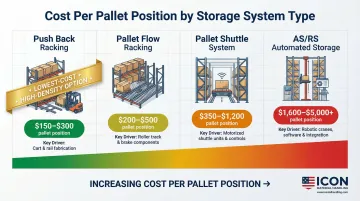
RMI notes that push back lanes generally cost around 65% of the price of a comparable pallet flow lane because they lack complex speed controllers and brakes.
Reduced rack damage costs:
Drive-in systems are described as "caves made of steel" where damage is frequent due to tight clearances (2-3 inches). Replacing a single damaged upright frame can cost $2,120 (including freight and labor), while an engineered repair kit averages $1,065. Push back systems keep forklifts in the aisle, dramatically reducing these recurring costs.
KPIs impacted:
- Labor cost per pallet moved
- Total cost of rack ownership
- Maintenance spend
- Off-site storage costs eliminated
When this advantage matters most:
Operations with tight labor budgets, facilities weighing high-density storage investment options, and warehouses where rack damage from forklift entry is a recurring cost.
What Happens When Push Back Racking Is Overlooked
The advantages of push back racking become most visible when you look at what operations sacrifice by defaulting to conventional selective or drive-in systems. The costs show up across space, labor, and safety:
Wasted aisle space that caps storage capacity and forces early decisions about facility expansion or off-site storage contracts — either option adds cost without adding throughput.
Higher forklift cycle times and labor costs as operators traverse inefficient rack layouts to access pallets — without gravity-assisted retrieval, every pick takes longer.
Elevated accident rates and rack damage from forklifts entering lanes in drive-in configurations, driving up repair costs, downtime, and workers' compensation claims.
Inventory management complications when all pallets in a drive-in lane must share the same SKU, limiting product mix flexibility and forcing suboptimal inventory placement decisions.
Overspending on the wrong system: Without comparing options, operations frequently pay for drive-in rack configurations that carry more mechanical complexity and higher long-term maintenance costs than their actual throughput demands.
How to Get the Most Value from Push Back Racking
Push back racking performs best when properly matched to the operation. It is most effective for products with 2 or more pallets per SKU and medium-to-high inventory turnover. Operations with only one pallet per SKU should evaluate selective racking instead.
Lane depth — whether 2-deep or 6-deep — should be driven by actual inventory data, not available floor space:
- Average pallets per SKU
- Replenishment frequency
- Available ceiling height
- Forklift specifications
Getting that configuration right before installation matters — errors are costly to reverse. Icon Material Handling's engineering team works directly with warehouse operators to model the right layout, make better use of vertical space, and design systems that accommodate growth without requiring facility expansion.
Track storage utilization rates and pick cycle times quarterly to confirm the system is being loaded and rotated correctly. Lanes that sit consistently under-utilized are a signal to reassign SKUs or redistribute inventory across the system.
Conclusion
Push back racking's advantages — higher density, faster and safer operations, and lower operating costs — translate directly into measurable warehouse KPIs. Reclaimed aisles, faster pick cycles, and fewer rack incidents each add up — and the gains compound as throughput volume increases.
Push back racking is not a universal solution, but for warehouses storing multiple pallets of the same SKU with medium-to-high turnover, it delivers a strong return on investment. The key is pairing the right system design with disciplined inventory management from day one.
Frequently Asked Questions
What is the difference between push back racking and drive-in racking?
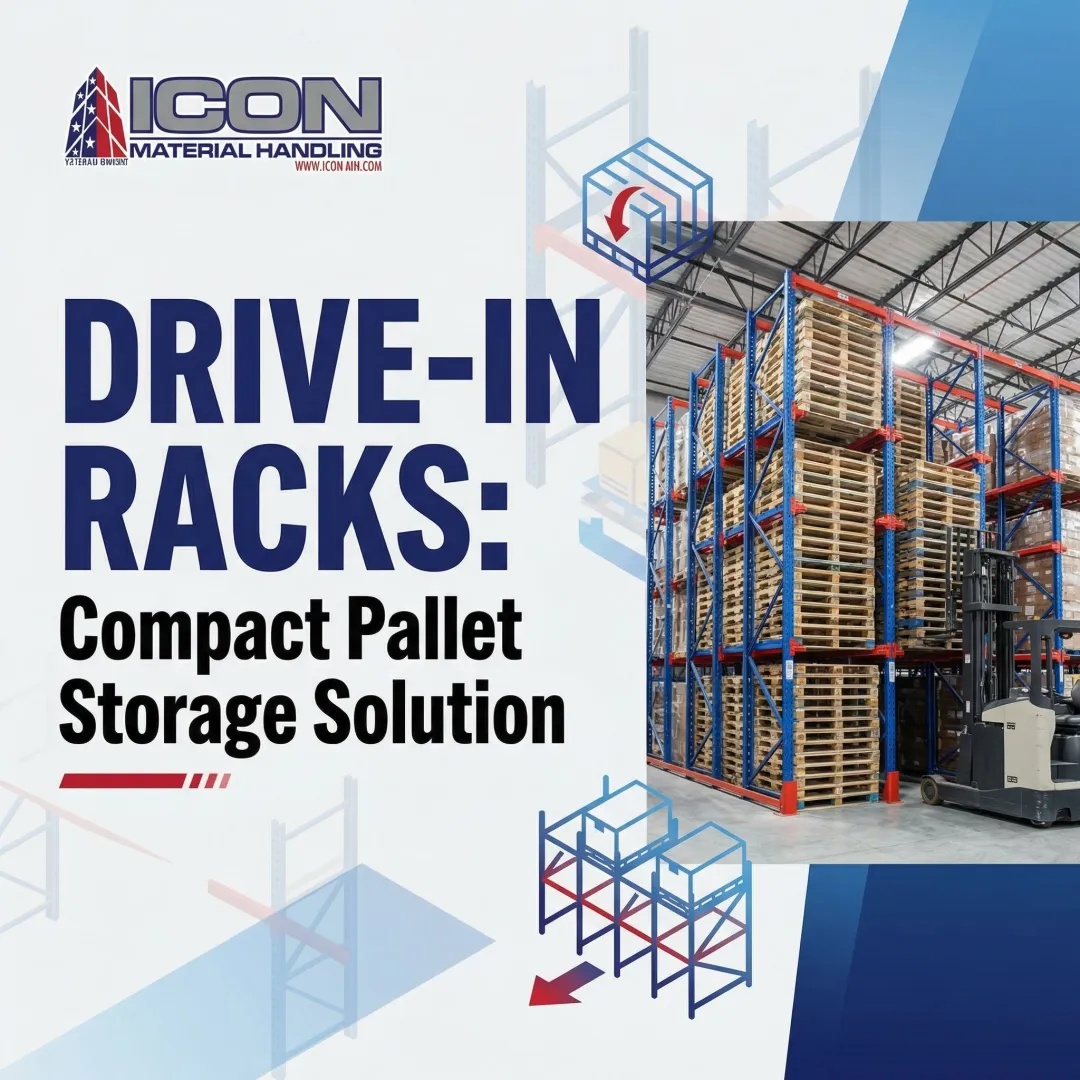
In drive-in racking, forklifts physically enter the lane to deposit pallets, creating safety risks and requiring all pallets in a lane (across all levels) to share one SKU. Push back racking uses gravity-fed carts so forklifts never enter the rack, and each level can hold a different SKU, delivering significantly greater selectivity — often cited at up to 4x that of drive-in systems.
How many pallets deep can a push back racking system go?
Push back racking accommodates 2 to 6 pallets deep per lane. The optimal depth is determined by ceiling height, pallet weight, and the number of pallets per SKU in your operation. Deeper configurations require more vertical clearance for the inclined rails.
Is push back racking suitable for FIFO inventory management?
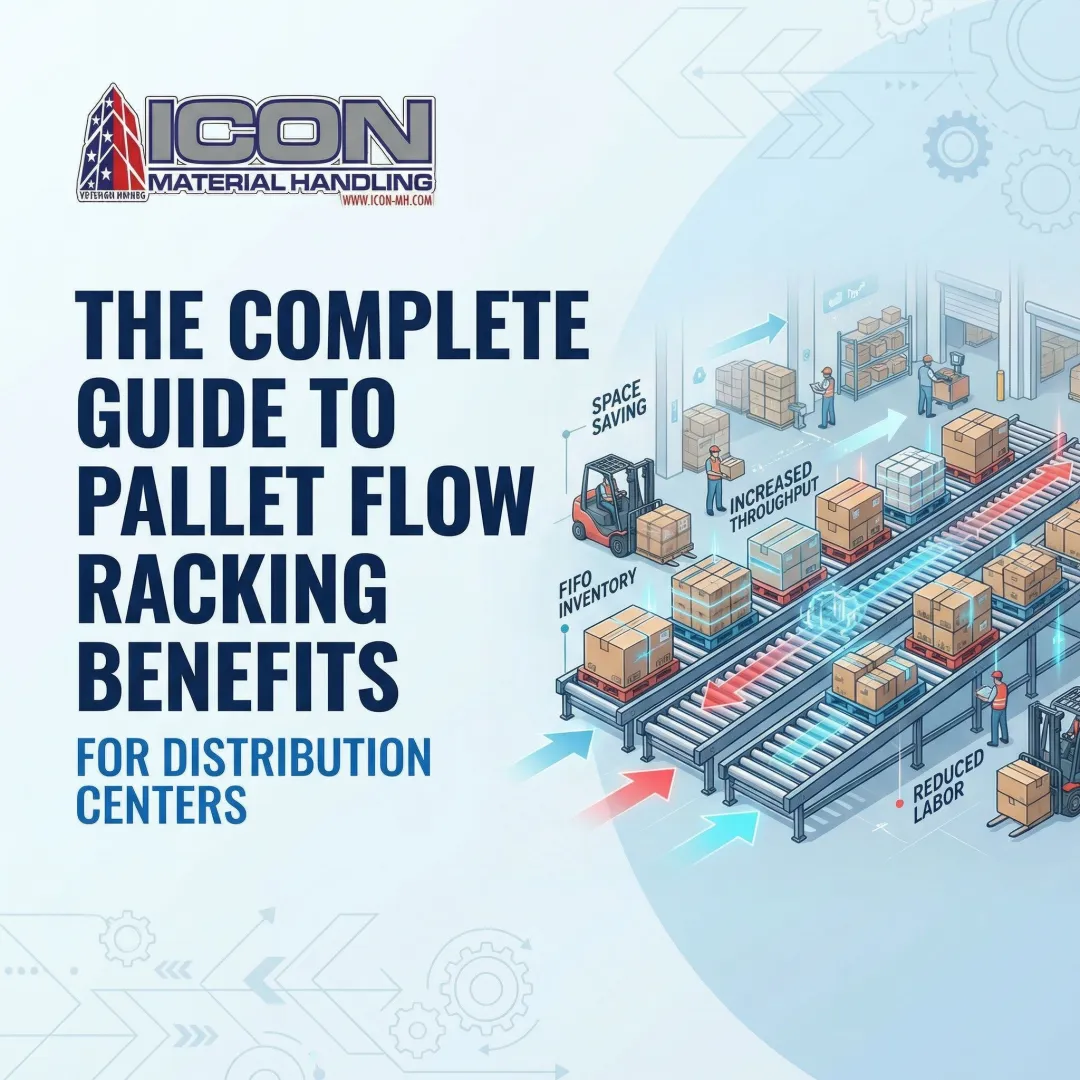
Push back racking operates on a LIFO (last in, first out) basis because pallets are loaded and retrieved from the same aisle face. Operations requiring strict FIFO rotation — such as perishable goods with expiration dates — should consider pallet flow racking instead.
What types of products and industries are best suited for push back racking?
Push back racking works best for non-perishable products stored in multiples of 2 or more pallets per SKU. Common applications include:
- Automotive parts distribution
- Food and grocery warehousing
- Retail distribution centers
- 3PL facilities
- Manufacturing operations with medium-to-high inventory turnover
How much storage capacity can push back racking add compared to standard selective racking?
Push back racking delivers 25% to 65% greater cubic density than selective racking. Real-world retrofit projects have documented capacity increases of 50% to 68% within the same footprint. Results depend on lane depth configuration and your current aisle-to-rack ratio.
Does push back racking work in cold storage or freezer environments?
Yes, push back racking is compatible with cold storage and freezer environments. Cart wheels feature stainless steel construction and sealed bearings that flow reliably at temperatures as low as -30°F (-30°C). This makes push back racking a practical high-density option for food and pharmaceutical cold chain operations.