Introduction
Most distribution centers are squeezing more SKUs, faster cycle times, and tighter accuracy requirements into the same square footage they had five years ago. At a certain point, picking up the pace isn't enough — the storage system itself becomes the constraint.
Pallet flow racking comes up in nearly every warehouse design conversation, yet its real value only becomes clear when you examine what it actually changes on the floor. This guide breaks down the specific, measurable advantages pallet flow racking delivers in distribution center environments, when those advantages matter most, and what's at stake without it.
TL;DR
- Pallet flow racking uses gravity-fed inclined rollers to automatically advance pallets from loading to picking in FIFO order
- It increases storage density by eliminating excess aisles, letting distribution centers store more product in the same square footage
- Enforces automatic inventory rotation—ideal for date-sensitive, perishable, or compliance-regulated products
- Separate aisles cut forklift-pedestrian conflicts and accelerate order fulfillment
- Best ROI in high-volume environments where throughput speed and inventory accuracy directly drive cost and customer satisfaction
What Is Pallet Flow Racking?
Pallet flow racking is a dynamic storage system built on inclined rail lanes fitted with rollers or wheels. Pallets are loaded at the high end (rear), gravity moves them to the low end (front), and each unloaded pallet automatically triggers the next to roll into the picking position—no forklift repositioning required.
It's most commonly deployed in environments where inventory rotation speed and storage density both matter, including:
- Distribution centers and fulfillment operations
- Food and beverage warehouses
- Cold storage facilities
- Pharmaceutical distribution environments
Pallet flow racking is available in both new and used configurations, giving distribution centers options regardless of capital budget. That flexibility in sourcing — new or used — means the system can fit operations at nearly any scale, which is why it appears throughout the sections that follow.
Key Advantages of Pallet Flow Racking for Distribution Centers
The three advantages below map directly to metrics distribution center managers track: space cost, labor cost, order accuracy, throughput speed, and inventory shrinkage. A system that stores more product, rotates inventory automatically, and keeps labor paths efficient reduces costs on day one—and keeps lowering them as operations scale.
Advantage 1: High-Density Storage That Converts Aisle Space Into Revenue-Generating Capacity
Unlike selective pallet rack—which requires an access aisle for every bay—pallet flow racking consolidates storage into deep lanes that can hold up to 12 or more pallets, requiring only a loading aisle at the rear and a picking aisle at the front. This dramatically increases the number of pallets that fit within the same footprint.
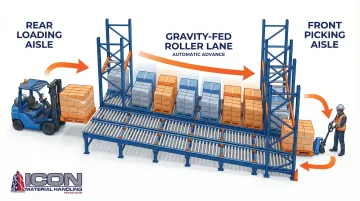
How this works in practice: A distribution center running selective rack may dedicate significant floor space to aisles; converting high-velocity SKU zones to pallet flow can recover a substantial portion of that space, allowing either more SKUs to be held in the same building or the same inventory to be held in a smaller, less costly facility.
Why Storage Density Reduces Cost Per Pallet Position
Every square foot of warehouse space carries a real cost—lease, utilities, insurance, taxes. Increasing storage density directly reduces the cost-per-pallet-position stored. In 2023, taking rents for North American big-box industrial facilities averaged $8.08 per square foot per year, a nearly $1.00 increase over 2022. While rent growth has cooled, Prologis reports that U.S. market rents remain 59% higher than 2019 levels.
Flow storage systems can reduce space requirements by up to 50% compared to conventional solutions. A Procter & Gamble distribution center, for example, demonstrated a 35% capacity increase (from 20,000 to 27,000 pallet spaces) within the same footprint after retrofitting with dynamic storage modules.
Capital planning impact: Distribution centers that maximize existing space avoid or defer the cost of building expansion, leasing additional facilities, or relocating to larger spaces—all of which carry multi-year financial consequences.
KPIs Impacted
- Cost per pallet position
- Square footage utilization rate
- Number of SKU positions available
- Facility lease cost per unit stored
- Storage capacity expansion without capital construction spend
When High-Density Storage Has the Greatest Impact
High-density storage pays off most in:
- Facilities operating in high-cost real estate markets
- Operations approaching storage capacity limits
- Cold storage and freezer environments where cubic space is especially expensive to build and maintain
- Distribution centers handling a large number of pallets of the same SKU
Advantage 2: Automatic FIFO Rotation That Protects Inventory Integrity and Compliance
FIFO (first-in, first-out) inventory rotation means the oldest stock always exits first—and pallet flow racking enforces this automatically through gravity, without any reliance on operator discipline, labeling accuracy, or manual rearrangement.
How this plays out operationally: Pallets are loaded from the back of the lane in the order they arrive; they move toward the picking aisle sequentially; the picker always accesses the longest-stored pallet without making any rotation decisions. This removes the human variable from inventory rotation entirely.
Why Mechanical FIFO Outperforms Procedural Controls
The direct financial impact of failed FIFO rotation is significant: expired product cannot be sold and must be written off. In regulated industries (food, beverage, pharma, medical devices), it can also trigger compliance violations and audit failures.
Regulatory context: For pharmaceutical operations, 21 CFR 211.150 mandates that "oldest approved stock shall be distributed first". For food distribution, 21 CFR 117.93 requires storage that protects against "deterioration of the food"—making FIFO functionally mandatory, not optional.
Financial impact: The average warehouse experiences an inventory shrinkage rate of 0.2% measured against inventory value, with rates exceeding 0.46% signaling a need for immediate corrective action. A seemingly small 1% shrinkage rate can eliminate 10% or more of net profit margins.
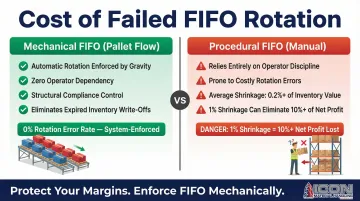
Beyond financial loss, poor inventory rotation creates stockout-masking: inventory appears available in the WMS but is expired or damaged, leading to order errors and downstream customer claims that erode service-level agreements.
Risk management: Enforcing FIFO mechanically—rather than procedurally—is a structural control, not a training dependency. It reduces liability and removes a recurring audit finding in regulated distribution environments.
KPIs Impacted
- Inventory shrinkage rate
- Product write-off costs
- FIFO compliance rate
- Order accuracy rate
- Regulatory audit outcomes
- Customer return and claim rates
Where FIFO Enforcement Is Non-Negotiable
FIFO is non-negotiable in:
- Food and beverage distribution (expiration dates)
- Pharmaceutical and medical device distribution (lot and expiry tracking)
- Seasonal products with hard sell-by windows
- Any operation storing high-value perishables where a single pallet write-off represents significant financial loss
Advantage 3: Improved Throughput and Labor Efficiency Through Separated Operational Zones
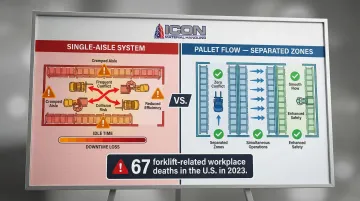
Pallet flow racking creates two physically distinct operational zones within a single storage bay: a loading aisle at the back (for receiving/replenishment forklifts) and a picking aisle at the front (for order fulfillment). These zones operate simultaneously without conflict, which is impossible with single-aisle racking systems.
What this changes in daily operations: Replenishment and picking activities no longer compete for the same aisle. Pickers are not waiting for forklifts to clear; forklift operators are not navigating around pickers. Each function runs at full speed, simultaneously, in its own lane—and when the front pallet is removed, the next pallet is already in position.
Why Separated Zones Accelerate Both Replenishment and Picking
Labor cost impact: In a conventional single-aisle setup, forklift-picker aisle conflicts result in idle time, repositioning delays, and reduced picks-per-hour. A case study of GLK Foods documented savings of approximately 150 hours of forklift double-handling during a single fall harvest season after installing a 5-level pallet flow system.
Order fulfillment speed: Faster picks per shift directly reduces cost-to-fulfill per order and improves on-time shipment rates—two metrics that directly affect customer satisfaction scores and contract renewals for 3PLs and distribution operations.
Safety dimension: Separating forklift and pedestrian zones is one of the most consistently recommended warehouse safety practices. In 2023, forklifts were involved in 67 work-related deaths in the U.S. Fewer combined-aisle interactions means fewer near-miss incidents and a lower probability of OSHA-recordable injury events, which carry both direct cost (medical, legal) and indirect cost (lost productivity, insurance rate increases) consequences.
KPIs Impacted
- Picks per hour
- Order cycle time
- On-time shipment rate
- Forklift utilization rate
- Labor cost per order
- OSHA recordable incident rate
- Workers' compensation costs
Where Throughput Separation Has the Greatest Impact
Separated operational zones pay off most in:
- High-velocity distribution centers processing large daily order volumes
- Facilities running multiple shifts where replenishment and picking overlap
- Operations with narrow fulfillment windows (same-day or next-day shipping commitments)
- Any facility where forklift-pedestrian incidents have been a recurring safety concern
What Happens When Pallet Flow Racking Is Overlooked
Distribution centers running conventional single-aisle or selective rack systems in high-velocity zones run into the same problems—repeatedly. Aisles clog with forklifts and pickers, manual rotation breaks down the moment operator discipline slips, and inventory records drift from physical reality as expired or mispositioned product quietly accumulates.
The compounding consequences:
- Product write-offs and audit findings increase when FIFO rotation depends on individual operators rather than system design
- Shared aisles between forklifts and pickers create injury risk and slow throughput — both problems that get worse as order volume climbs
- Capacity ceilings arrive earlier than they should, pushing facilities toward expensive expansions that a smarter racking layout could have avoided
- Peak-period bottlenecks — such as seasonal surges — can't be solved by adding headcount alone when the system design itself is the constraint
How to Get the Most Value from Pallet Flow Racking
Pallet flow racking delivers its full benefit only when correctly specified for the operation. Lane depth must match replenishment frequency, the incline angle and roller configuration must suit pallet weight and condition, and speed controllers or braking systems must be selected for fragile or heavy loads.
An improperly designed system underperforms — and can cause the product damage it was meant to prevent.
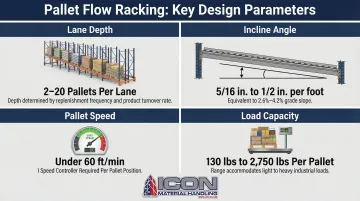
Key design specifications:
- Lane depth ranges from 2 to 20 pallets per lane, depending on facility depth and replenishment frequency
- Incline typically falls between 5/16-inch and 1/2-inch per foot (roughly 2.6% to 4.2%)
- Pallet speed should stay under 60 feet per minute, with one speed controller per pallet position
- Standard systems support loads from approximately 130 lbs to 2,750 lbs per pallet
The system works best when lane assignments are reviewed as inventory mix evolves. When SKU velocity profiles shift, high-turn products should stay in pallet flow positions — not the positions that made sense at installation.
Icon Material Handling offers custom design, engineering, and fully insured installation for pallet flow systems, with both new and used equipment options to fit different capital budgets. Getting the specifications right from the start — weight requirements, product types, throughput targets — prevents costly adjustments later.
Conclusion
Pallet flow racking delivers measurable improvements across the metrics distribution center managers are most accountable for:
- Storage density — more pallets in the same footprint
- Inventory integrity — automatic FIFO rotation without process enforcement
- Throughput speed — continuous product flow with no manual repositioning
- Labor efficiency — fewer touches per pallet, less time locating product
- Workplace safety — reduced forklift-pedestrian conflicts and aisle congestion
These gains become more pronounced as order volumes grow. A well-designed system scales with the operation — the structural efficiency built into the lanes handles higher throughput without adding labor or reconfiguring the floor.
Treat pallet flow racking as an operational asset, not a one-time install. Periodic reviews of lane configuration, roller condition, and load profiles keep the system performing as demand patterns shift — and protect the return on the original investment.
Frequently Asked Questions
How many pallets deep can a pallet flow rack system store?
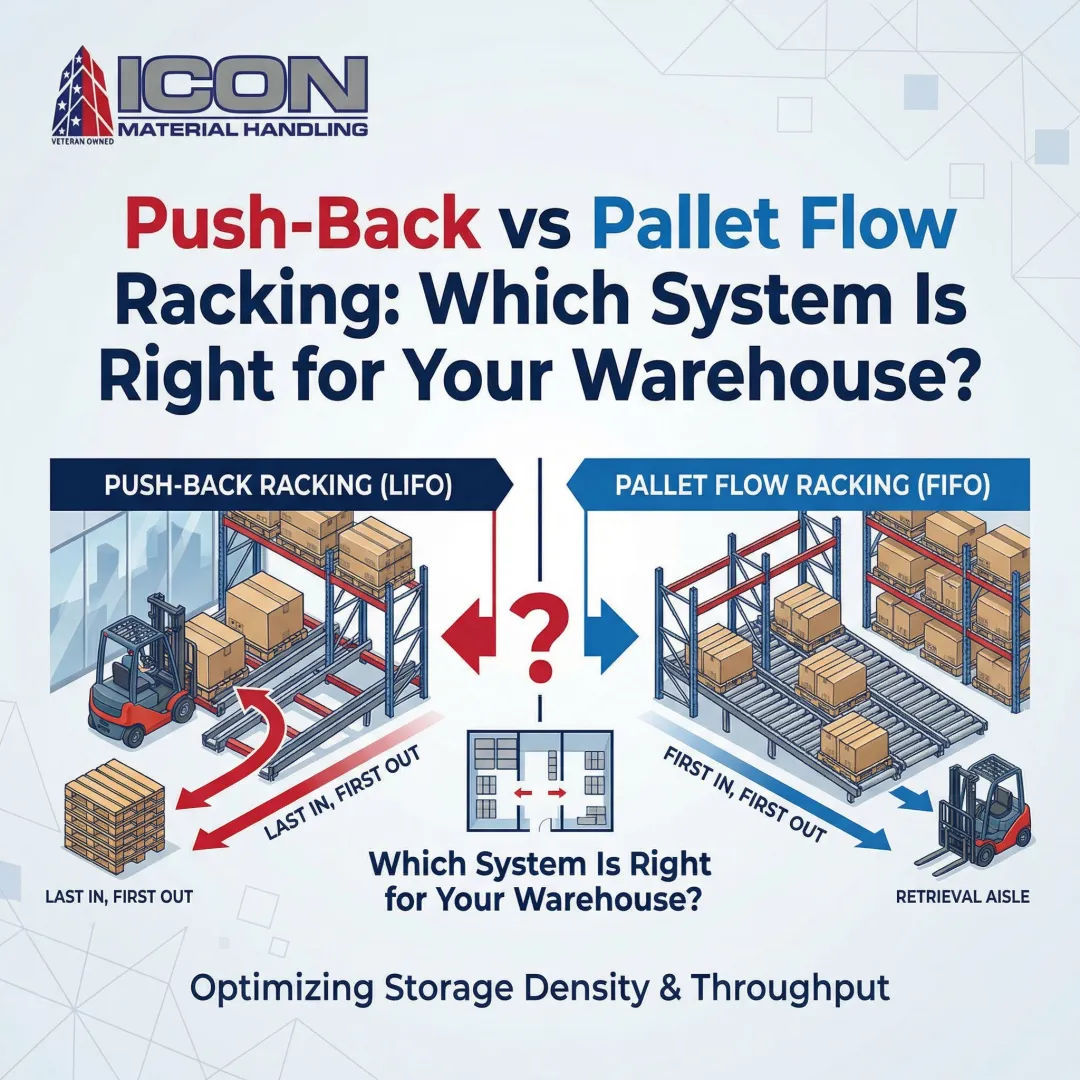
Pallet flow rack can typically store up to 12 or more pallets deep per lane, depending on the system design and available facility depth—significantly more than push back rack, which is generally limited to 6 pallets deep.
What types of products are best suited for pallet flow racking?
Pallet flow racking works best for date-sensitive, perishable, or high-rotation products—including food and beverage, pharmaceuticals, medical devices, and consumer goods—where FIFO inventory rotation is operationally required or mandated by regulation.
How does pallet flow racking differ from push back racking?
Pallet flow rack is a FIFO system that uses two separate aisles (loading and picking) and can store more pallets deep; push back rack is a LIFO system that uses a single aisle for both loading and unloading, making it better suited for non-date-sensitive products and tighter spaces.
Is pallet flow racking suitable for cold storage or freezer environments?
Yes. Pallet flow racking is widely used in cold storage and freezer applications—its high-density design reduces refrigerated cubic space needed, cutting a major cost driver, while FIFO rotation keeps perishable products moving in the correct sequence.
Can pallet flow racking be reconfigured or expanded after installation?
Pallet flow racking systems are modular and can be reconfigured to adjust lane depth, width, or roller configuration as inventory needs change. Any reconfiguration should be reviewed by a qualified designer to ensure safe, efficient performance.
How do speed controllers and braking systems work in pallet flow racking?
Speed controllers and brakes are built into pallet flow lanes to regulate travel speed from the loading end to the picking position. This prevents pallets from building excessive momentum—particularly important for fragile, heavy, or high-value loads.