Introduction
Many warehouse and facility managers face a familiar challenge: inventory is growing, staff headcount is increasing, but floor space isn't. Traditional solutions—relocating to a larger facility or constructing a building addition—bring steep costs, operational disruption, and long timelines. Mezzanine floors offer a smarter alternative by unlocking unused vertical space within your existing structure, doubling usable square footage without expanding your building footprint.
Modern U.S. warehouses average 32–36 feet in clear height, with many facilities exceeding 40 feet. Yet most operations use only the ground level, leaving thousands of cubic feet of capacity untapped. A well-designed mezzanine converts that overhead space into functional storage, office space, or production zones at a fraction of the cost of new construction—with no facility move required.
This guide covers what mezzanine floors are, the most common uses in warehouse and office settings, essential features to evaluate, and key planning considerations before installation.
TLDR:
- Mezzanines add a second level within existing buildings, doubling usable space without expanding the footprint
- Costs typically run $40–$250 per sq. ft.—well below new construction at $60–$130 per sq. ft.
- Match load capacity, deck material, and access systems to your intended use: storage, office, or production
- Permits and IBC compliance are required, but installation causes minimal disruption to active operations
- Freestanding systems can be relocated or expanded as your business grows
What Is a Mezzanine Floor?
A mezzanine floor is a semi-permanent elevated platform built between a facility's floor and ceiling — a secondary level within the existing structure that adds usable space without expanding the building footprint. Under the International Building Code (IBC) Section 505.2, a compliant mezzanine is classified as "a portion of the story below" and does not count toward building area or story limits, provided it meets specific size and clearance criteria.
Unlike temporary scaffolding, mezzanines are engineered structural additions designed to support substantial loads and daily operational use.
Structural Composition
Industrial mezzanines typically consist of:
- Columns: Square tube (HSS) structural steel providing vertical support
- Framing: Wide-flange beams or C-channel joists forming the horizontal structure
- Decking: Load-bearing surface—steel grating, composite board, or solid steel plate
- Safety components: Industrial stairways, handrails meeting OSHA standards, toe boards, and pallet gates for material transfer
Where Mezzanines Are Used
Mezzanines are installed across a range of facility types:
- Warehouses and distribution centers
- Manufacturing plants and assembly facilities
- Office buildings requiring additional workspace
- Industrial storage facilities
In each setting, the goal is the same: reclaim unused vertical space without the cost or disruption of a new construction project.
Top Uses for Mezzanine Floors in Warehouses and Offices
The right application depends on available headroom, load requirements, and operational goals. Here are the most common and high-value uses.
Warehouse Storage and Pallet Racking Expansion
Mezzanines extend pallet racking systems vertically, enabling businesses to use the full clear height of a facility. Rather than rearranging floor-level racking, a mezzanine layer doubles usable storage positions—critical for operations managing high SKU counts or seasonal inventory surges.
Key benefits:
- Maximizes storage density without expanding the building
- Accommodates rack-supported or freestanding configurations
- Ideal for facilities with 28+ feet of clear height
Office Space Above the Warehouse Floor
One of the most common applications is building an office mezzanine above active warehouse operations. This gives managers, supervisors, and administrative staff dedicated workspace while preserving floor space for picking, packing, and staging.
An elevated position also provides a natural sightline over the warehouse floor, improving oversight and operational coordination. These mezzanines can be engineered to exact dimensions and configured around specific workflow requirements.
Production and Light Manufacturing Zones
Mezzanines can host production lines, assembly stations, or quality control areas on an elevated level. Goods are transported between floors via conveyors, goods lifts, or stairs, allowing businesses to combine storage and production capacity in a single footprint.
Best suited for: Facilities with limited ground-level space but 20+ feet of vertical clearance, where separating production and storage functions improves workflow without requiring a larger building footprint.
Administrative and IT Support Areas
Mezzanine space works well for administrative functions, IT server rooms, and automation control centers. Common setups include:
- Monitoring stations with direct sightlines to the floor below
- IT server rooms isolated from ground-level foot traffic and dust
- Automation system control centers positioned close to the equipment they manage
Keeping these support functions near the warehouse floor shortens response times and keeps operations running smoothly.
Archive and Document Storage
For businesses with compliance obligations around physical records—particularly in regulated industries—mezzanines provide organized, high-density archive storage. Tiered shelving on mezzanine levels allows for efficient retrieval without expanding the building.
Key Features to Look for in a Mezzanine Floor System
Load Capacity and Structural Rating
Load capacity, measured in pounds per square foot (PSF), is the most critical specification to confirm before designing a mezzanine. According to IBC Table 1607.1 and ASCE 7, typical load ratings include:
- Office use: 50 PSF UDL plus a 2,000 lb concentrated load
- Light manufacturing/storage: 125 PSF UDL plus a 2,000 lb concentrated load
- Heavy manufacturing: 250 PSF UDL plus a 3,000 lb concentrated load
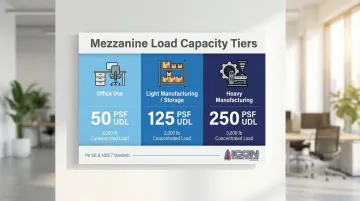
Uniform Distributed Loads (UDL) apply to general storage across the entire deck. Point loads represent concentrated weight from machinery, rack legs, or heavy equipment, typically assumed to be distributed over a 2.5 ft x 2.5 ft area.
Critical: Specify your heaviest anticipated use case, not just current use. Under-designing for point loads is a common cause of structural failure.
Deck Material Options
The right decking material depends on your intended application:
| Deck Material | Best Application | Key Characteristics |
|---|---|---|
| Steel Bar Grating | Wash-down areas, food/beverage facilities | Allows light, air, and water to pass through; may eliminate sprinkler requirements below the deck (subject to local approval); not suitable for small-wheeled carts |
| Composite Resin Board | Pallet jack traffic, AMR zones, office mezzanines | High wheel-load capacity (up to 8,000 lbs); ergonomic and quiet; available with ESD finishes; requires corrugated steel sub-deck |
| Solid Steel Plate | Heavy industrial use, foundries, heavy manufacturing | Extreme durability; resists point load damage; noisy; expensive; often requires sprinklers below due to solid surface |
Selection rule: Bar grating for storage areas with ventilation needs, composite for office or high-traffic levels, solid plate for extreme point loads.
Access Systems: Stairs, Lifts, and Pallet Gates
Once the deck surface is set, access planning comes next — getting personnel and materials moving between levels safely and in compliance with code.
Industrial Stairways (OSHA 1910.25 / IBC 1011):
- Angle: 30° to 50° from horizontal
- Maximum riser height: 9.5 inches
- Minimum tread depth: 9.5 inches
- Minimum width: 22 inches
- Minimum headroom: 6 feet 8 inches
- Load capacity: 5 times anticipated live load or 1,000 lbs concentrated load, whichever is greater
Goods Lifts (VRCs):Vertical Reciprocating Conveyors are governed by ASME B20.1, not elevator codes. They move materials only—riders are prohibited. VRCs are essential for facilities transferring pallets or equipment between levels.
Pallet Gates:Allow safe forklift-to-mezzanine transfers. Self-closing gates or offsets are required; chains alone do not meet permanent installation standards.
Handrails, Edge Protection, and Safety Features
Safety components are not optional add-ons—they are code-required elements that protect personnel.
OSHA 1910.29 / IBC 1015 requirements:
- Guardrails: Top rails must be 42 inches (±3 inches) above the walking surface and withstand a 200 lb force
- Handrails: Required on stairs; height of 30–38 inches (OSHA) or 34–38 inches (IBC)
- Toe boards: Minimum 3.5 inches high with no more than 0.25-inch clearance above the floor; must withstand a 50 lb force
- Non-slip surfaces: Coatings or textured decking to prevent slips on elevated platforms
Fall protection is a primary enforcement focus for OSHA. Compliance is mandatory.
Modular and Expandable Design
Modular mezzanine systems can be expanded, reconfigured, or relocated as business needs change. Freestanding mezzanines—not bolted to the building structure—offer the greatest flexibility for future layout changes.
Key advantages of modular systems include:
- Expandable without full structural redesign
- Reconfigurable when operations or layouts shift
- Relocatable if your facility moves or footprint changes
- Available in both new and used configurations for cost control
Icon Material Handling engineers mezzanine systems to a facility's exact dimensions, load requirements, and operational needs — in both new and used configurations.
Benefits of Mezzanine Floors Over Traditional Expansion
Mezzanines are often the preferred choice compared to relocating to a larger facility or adding a building extension. Here's why.
Cost Efficiency vs. Building Expansion or Relocation
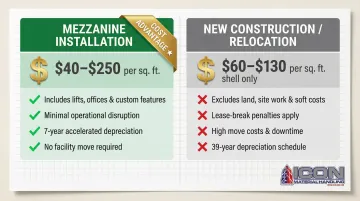
Mezzanine installation costs typically range from $40 to $250 per sq. ft., depending on size, materials, load capacity, and features like lifts or offices. New warehouse construction, by contrast, runs $60 to $130 per sq. ft. for the shell alone — before land, site work, or soft costs.
Beyond construction costs, relocation adds lease-break penalties, physical move costs, and operational downtime. On the tax side, mezzanines qualify as capital equipment rather than real property — enabling accelerated depreciation over 7 years instead of 39.
Minimal Disruption to Active Operations
Installation is typically phased to keep operations running. Crews work around production schedules, and the main floor stays functional throughout — a clear contrast to a full facility move or major construction project, which can disrupt operations for weeks or months.
Space Utilization Without a Larger Footprint
Mezzanines effectively multiply usable floor area by harnessing clear height—a resource most warehouses already have but underutilize. Increasing clear height from 32 ft to 40 ft allows for approximately 25% more inventory in the same footprint. A mezzanine converts that overhead space into productive square footage you're already paying rent on.
Long-Term Flexibility and ROI
Unlike permanent construction, a mezzanine adapts as the business changes. Common reconfigurations include:
- Repurposing storage levels for office or break room use
- Adding a second tier as volume grows
- Disassembling and relocating the structure to a new facility
That flexibility delivers a stronger ROI than fixed construction, which locks you into a single layout indefinitely.
Types of Mezzanine Floor Structures
Not all mezzanines are built the same. The right structure type depends on facility layout, intended use, and how the mezzanine integrates with existing equipment.
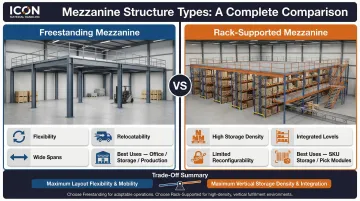
Freestanding vs. Rack-Supported Mezzanines
Freestanding Mezzanines:
- Self-supporting columns, not attached to the building
- High flexibility and relocatability
- Wide spans allow open floor space below
- Best for offices, bulk storage, production zones, conveyor support
Rack-Supported Mezzanines:
- Built on top of existing pallet racking systems
- Ideal for operations integrating storage at multiple levels without separate support columns
- Lower flexibility; tied to the rack grid
- Best for high-density SKU storage and pick modules
Trade-off: Freestanding systems offer greater long-term flexibility but require dedicated columns. Rack-supported systems maximize storage density but are harder to reconfigure.
Multi-Tier Mezzanine Systems
For facilities with very high ceilings (typically 28+ feet), multi-level mezzanines can add 2–3 levels of storage. Each additional tier multiplies usable space but requires careful load engineering, seismic design, and fire/egress planning.
Multi-tier systems are common in large distribution centers and archive storage environments where vertical space is abundant.
Custom-Engineered Systems for Specialized Needs
Some operations require mezzanines built around unique constraints:
- Unusual column spacing
- Integration with conveyors or automation equipment
- Specialized surface requirements (cleanrooms, food-safe areas)
Custom-engineered mezzanines — such as those Icon Material Handling designs and installs — are built to the specific constraints of the facility and workflow, accounting for column placement, equipment integration, and surface requirements from the ground up.
Important Considerations Before Installing a Mezzanine Floor
Before moving from interest to planning, use this checklist to ensure your project is feasible and compliant.
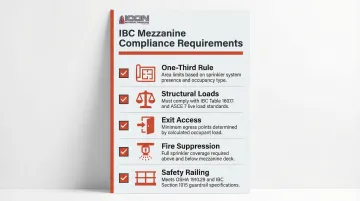
Building Codes, Permits, and IBC Compliance
Mezzanine installations in the U.S. typically require a building permit and must comply with the International Building Code (IBC) as well as local jurisdiction requirements.
Key code areas:
- One-third rule: Mezzanine area generally cannot exceed one-third of the room's floor area — up to one-half with sprinklers and voice/alarm systems, or two-thirds for special industrial occupancies.
- Structural loads: Floor load ratings must meet IBC Table 1607.1 and ASCE 7 standards for your intended use case
- Exit access: Occupant loads under 49 require at least one egress point; larger areas require two or more exits
- Fire suppression: Sprinklered buildings must install protection both above and below the mezzanine deck, especially with solid flooring
- Safety railing standards: Guardrails and handrails must meet OSHA 1910.29 and IBC 1015 specifications
Action item: Confirm local requirements with your jurisdiction before proceeding.
Available Headroom and Site Constraints
IBC 505.2 mandates a minimum clear height of 7 feet both above and below the mezzanine floor. However, industry best practice suggests a total clear height of 14–16 feet is required to accommodate:
- 7 ft minimum clearance above and below
- Structural depth of the deck (beams/joists)
- Clearance for lights, HVAC ducts, and sprinkler lines
Site-specific considerations:
- Existing slab capacity must support point loads from mezzanine columns (requires structural engineer analysis)
- Overhead obstructions (ductwork, sprinklers, lighting) must be mapped during the design phase
- Column placement must avoid interfering with workflow or equipment
Choosing a Qualified Installation Partner
Once your site constraints are mapped, the right installation partner takes those findings and translates them into a permitted, engineer-stamped build. Look for a team that manages permitting in-house and provides documented engineering sign-off at project close.
What to look for:
- Experience with IBC and OSHA compliance
- In-house engineering and design capabilities
- Full insurance coverage
- References from similar projects
Icon Material Handling handles custom mezzanine design, permitting, and installation with a fully insured team — managing the process from initial site analysis through final inspection sign-off.
Frequently Asked Questions
How much does a mezzanine floor cost to install in a warehouse?
Cost varies significantly based on size, material, load capacity, and features like lifts or offices. Typical turnkey costs range from $40 to $250 per sq. ft. For an accurate estimate, request a site-specific quote based on your facility's dimensions, load requirements, and intended use.
Do mezzanine floors require a building permit in the US?
Yes, building permits are required for mezzanine installations in the U.S. under IBC and local codes. A qualified installer or contractor will manage the permitting process, ensuring compliance with fire suppression, egress, and structural requirements.
How much weight can a mezzanine floor support?
Load capacity depends on the design and materials. Typical industrial mezzanines range from 125 PSF (light storage) to 250 PSF (heavy manufacturing), with office areas at 50 PSF. Engineering to the heaviest anticipated load—including point loads from equipment or racking—is required, not just average use.
Can a mezzanine floor be relocated or expanded in the future?
Yes, freestanding mezzanines are designed to be disassembled and relocated. Modular systems can typically be expanded with additional bays or a second tier over time.
What is the minimum ceiling height needed for a mezzanine floor?
Most installations require at least 14–16 feet of clear height to deliver two usable working levels — 7 ft above and below per IBC. Existing ductwork, sprinklers, and structural depth should all be assessed before finalizing height requirements.
How long does mezzanine floor installation take?
Installation timelines vary by size and complexity. Small systems may take a few days, while larger or multi-level structures may take several weeks. Experienced installers minimize disruption to active operations throughout, often phasing work around production schedules.
Need a mezzanine system sized and engineered to your facility? Icon Material Handling provides custom mezzanine design, fabrication, and installation for warehouses and industrial facilities across the USA. Reach out at Sales@icon-mh.com or +1 248-971-1455 to discuss your project.