
Introduction
Walk into any warehouse, commercial kitchen, or storage facility and you'll see the same problem: wire shelving units that look full but feel chaotic. Products tip through gaps, small parts disappear into corners, and entire storage bays become impossible to navigate efficiently. The shelving isn't the problem. The strategy behind it is.
Wire shelving's open design, adjustability, and accessory compatibility make it uniquely suited for creative organization, whether you're managing a warehouse aisle, commercial kitchen, or industrial facility. Yet most operations set up their units once and never revisit the configuration, leaving real capacity and efficiency gains unrealized. This post covers 13 actionable ways to get more storage capacity and better organization from your existing wire shelving.
TLDR: 13 Ways at a Glance
- Adjust shelf heights to match actual item dimensions and reclaim wasted vertical space
- Add under-shelf baskets and hooks for instant bonus storage tiers
- Install liners to stabilize small items and support flat organizers
- Use dividers and clip-on bins to separate inventory and cut search time
- Place turntables on deep shelves to bring back-row items within reach
- Add casters for mobile, repositionable storage wherever it's needed
- Apply frequency-based zoning to cut pick travel and reduce physical strain
- Label every shelf clearly so anyone can locate and return items quickly
- Group items by category or workflow sequence to streamline picking
- Stack vertically using shelf risers to multiply usable tiers
- Corral loose items in bins or trays to prevent clutter and tipping
- Reinforce overloaded spans with additional wire shelf supports
- Audit shelf assignments regularly and reorganize as inventory mix changes
Ways 1–3: Use Every Inch of Vertical Space
Most wire shelving units ship with fixed adjustment slots spaced every inch, yet they're rarely configured optimally from the start. A quick audit of actual item heights often reveals 4–8 inches of wasted airspace per shelf—space that could house an entirely new shelf level. Research shows that failing to optimize vertical space can waste over 80% of paid storage volume in some facilities.
Way 1 — Adjust Shelf Height Increments
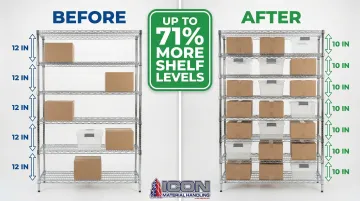
Measure the tallest item in each zone, then recalculate shelf spacing to match. If you're storing 9-inch boxes on shelves set 12 inches apart, you're wasting 3 inches per level. By resetting shelves to 10-inch intervals (leaving 1 inch clearance), you can often add one to two additional shelf levels in a standard 72-inch unit.
Before: 72-inch unit with 5 shelves at 12-inch spacing = 5 usable levels
After: Same unit with shelves at 10-inch spacing = 7 usable levels
Wire shelving adjusts in 1-inch increments, giving you precise control over vertical density. For small-item storage, adjusting from standard spacing to SKU-specific heights can increase shelf count by up to 71%.
Way 2 — Add Under-Shelf Baskets and Hooks
Clip-on wire baskets hang from the underside of any shelf, creating an immediate second storage tier for lightweight items like gloves, small parts, or produce. These accessories require zero assembly and no hardware changes—they simply hook onto the existing wire frame.
Every shelf effectively becomes two storage zones. Use under-shelf baskets for frequently accessed items that don't need a full shelf, or for overflow that would otherwise clutter primary storage surfaces.
Way 3 — Go Floor-to-Ceiling with High-Density Configurations
Standard wire shelving units can be extended vertically with additional post kits and shelf levels, adding capacity without buying new equipment.
For industrial settings, floor-to-ceiling configurations maximize every available foot. Taking this further, mobile track systems can increase capacity by 50% to 150% by eliminating fixed aisles and consolidating access to a single moving point.
Important: In healthcare sterile storage, AAMI ST79 guidelines require at least 8–10 inches clearance above the floor and 18 inches below ceiling or sprinkler heads. If your facility falls under healthcare, food safety, or fire code regulations, confirm clearance requirements with your compliance officer before reconfiguring shelf heights.
Ways 4–7: Leverage Accessories to Solve Specific Problems
Wire shelving's real organizational power comes from its accessories. The right add-ons address specific problems—unstable surfaces, mixed inventory, overflow items, or fixed positions—turning a standard unit into a system that fits your actual workflow. Skipping them is the most common wire shelving mistake.
Way 4 — Shelf Liners for Stability and Versatility
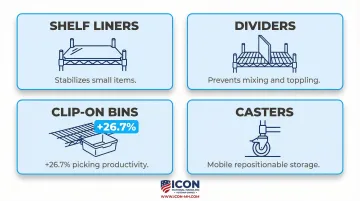
The open-wire surface causes small items to tip, round containers to roll, and organizers to sit unevenly. Shelf liners solve this by creating a solid, flat surface. Common use cases include:
- Stackable bins and containers that would otherwise wobble
- Clear flat-based organizers for parts or supplies
- Dividers and inserts that need a stable footing
Liners cut to size with scissors and install without tools.
In foodservice environments, liners also improve cleanability and help meet NSF/ANSI 2 standards for non-porous, corrosion-resistant surfaces.
Way 5 — Dividers to Prevent Mixing and Toppling
Wire or plastic shelf dividers snap onto wire shelves to separate product categories, keep stacks from falling sideways, and create clear visual lanes. This is particularly useful in food service, retail stockrooms, and pharmaceutical storage where product segregation is critical.
Dividers reduce mislocation errors and speed restocking. A national retailer that optimized wire shelving with accessories saw a 30% reduction in restocking time and a 15% increase in sales due to better stock availability.
Way 6 — Clip-On Bins and Side Panels for Overflow
Clip-on bins attach directly to the wire frame itself—not just the shelf surface—utilizing unused side and end panel space. This is ideal for frequently accessed small items like tools, hardware, or personal protective equipment.
In manufacturing settings, implementing bin-managed locations on shelving increased picking productivity by 26.7% and reduced order processing time by 26% by eliminating "search and rescue" missions for parts.
Way 7 — Casters for Mobile Shelving
Caster kits convert any static wire shelving unit into a mobile storage solution. Common applications include:
- Bringing inventory directly to picking stations in warehouses
- Repositioning prep supplies in commercial kitchens
- Rolling supply carts in healthcare and pharmaceutical storage
Safety note: Use locking casters rated to ANSI/ICWM:2012 standards. Mobile units typically support 600–1,000 lbs total—significantly less than stationary configurations—and OSHA requires casters to be locked whenever the unit is not in motion.
Icon Material Handling offers wire shelving systems with accessory compatibility across all major configurations, and can help facilities identify the right add-ons based on load type, environment, and workflow requirements.
Ways 8–10: Organize by Zone, Frequency, and Category
A well-configured shelving unit that's randomly stocked is still inefficient. Organizing by zone—access frequency, category, and user—directly reduces pick time, minimizes training overhead, and keeps high-traffic items within reach.
Way 8 — Apply Frequency-Based Shelf Assignment
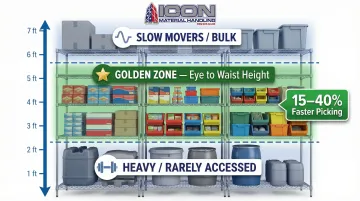
Place the most frequently accessed items at eye-to-waist height (the "golden zone"), slower-moving items above, and bulk or rarely touched inventory below. This directly reduces pick travel time and physical strain.
Industry data suggests picking from the golden zone takes 15% to 40% less time than picking from other tiers. The ergonomic advantage is clear: reducing bending and reaching minimizes fatigue and improves pick accuracy.
Way 9 — Group by Category or Workflow Stage
Label shelves by product category (e.g., "Dry Goods," "Cleaning Supplies," "Returns") to create intuitive navigation for multiple users and reduce mislocation errors. In industrial settings, this mirrors the principle of 5S workplace organization.
Category-based zoning allows workers to learn locations quickly, reducing training time and improving consistency. In one documented case, zone-based organization reduced average travel distance per picking route by 9.3% while eliminating expiration-date errors entirely.
Way 10 — Turntables and Lazy Susans for Deep or Corner Shelves
Even with strong zone discipline, deep shelves create a blind spot—items pushed to the back get forgotten or require full unloading to reach. A turntable brings all items to the front with a single spin, ideal for condiments, small parts bins, or medical supplies.
Choose turntable diameter based on shelf depth—a 16-inch turntable works well on 18-inch-deep shelves, while 24-inch shelves can accommodate larger rotating platforms. This simple accessory eliminates the "dig and dump" problem that wastes time and damages inventory.
Ways 11–13: Expand, Dedicate, and Reconfigure
The final three strategies move from organizing what's already on the shelf to redesigning how the overall system functions—particularly important as inventory changes or storage needs evolve.
Way 11 — Dedicate Specific Bays to Specific Item Types
Mixing item types on the same shelf unit creates confusion and slows retrieval. Assigning entire units or bays to seasonal, bulk, or specialty stock creates predictable storage geography that multiple users can navigate without constant direction.
Reserve one clearly marked "staging" bay for incoming and outgoing items. New inventory stays out of active storage, and returns or outbound orders have a defined holding spot instead of competing for shelf space.
Way 12 — Use Back-of-Unit Hooks and Hanging Storage
The rear wire frame of a shelving unit (or an adjacent wall) can support S-hooks, pegboards, or bungee cord organizers for long-handled tools, bags, or oversized items that don't sit well on shelves.
Unused vertical surfaces become functional storage without consuming shelf space. Items that hang well on hooks include:
- Brooms and mops
- Extension cords
- Aprons and PPE
- Bags and totes
Anything that would otherwise lean awkwardly against a shelf is a strong candidate for this approach.
Way 13 — Audit and Reconfigure Periodically, Don't Just Add More Shelves
The most overlooked organization strategy is a scheduled review. Purge expired or obsolete inventory, adjust shelf heights as product mixes change, and reassess zone assignments every quarter.
Reconfiguration often costs far less than purchasing new units. Modular wire shelving systems are designed for tool-free adjustment, so shelves can be added or repositioned in minutes. In one documented case, monthly audits raised 5S compliance from 71% to 100%, directly improving operational consistency.
For facilities managing larger-scale storage changes, Icon Material Handling offers installation and reconfiguration services alongside its broader inventory of wire shelving and warehouse storage solutions.
Frequently Asked Questions
Frequently Asked Questions
How do I keep small items from falling through wire shelving gaps?
Shelf liners are the most practical solution, creating a flat surface that prevents small items from tipping through. Clip-on bins can also corral loose items without modifying the shelf itself, and they attach directly to the wire frame for secure storage.
Can wire shelving support heavy industrial loads?
Yes, but load capacity depends on wire gauge, post diameter, and shelf configuration. Industrial-grade wire shelving units are rated for significantly higher weight limits than residential versions—typically 600–800 lbs per shelf and 2,000+ lbs per unit. Always check manufacturer specifications before loading.
What is the best way to label wire shelving?
Use clip-on label holders designed specifically for wire shelves, color-coded tags, or magnetic label systems. Consistent labeling reduces misplaced items and search time in multi-user environments. Avoid adhesive labels directly on wire, as they're difficult to remove and reposition.
How do I maximize storage without buying additional wire shelving units?
Adjust shelf heights to eliminate wasted airspace, add under-shelf baskets for bonus tiers, and use dividers or bins to increase density. A quick purge and audit often reveals more usable space than purchasing new hardware.
How do I clean and maintain wire shelving?
Wire shelving's open design resists dust buildup but benefits from periodic wipe-downs. Match your cleaning method to the finish: chrome for dry storage, epoxy-coated for wet or humid environments, and stainless steel for sterile or high-corrosion areas.
When should I reconfigure vs. replace my wire shelving system?
If posts and frames are structurally sound, reconfiguration is almost always more cost-effective than full replacement. Structural damage or chronic capacity shortfalls are the clearest signals that new investment is warranted.